
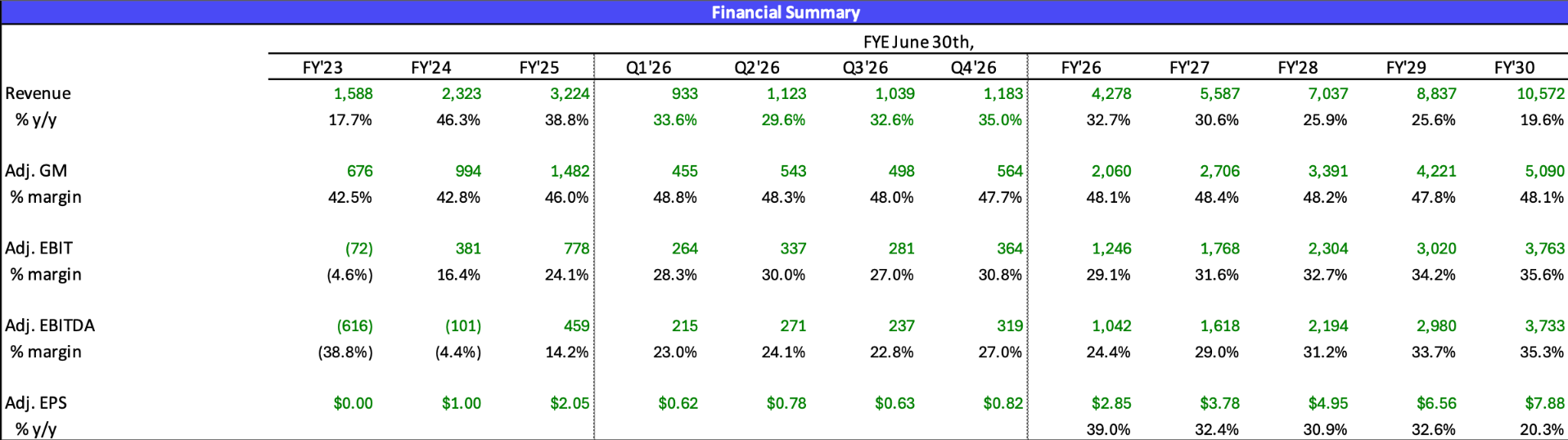
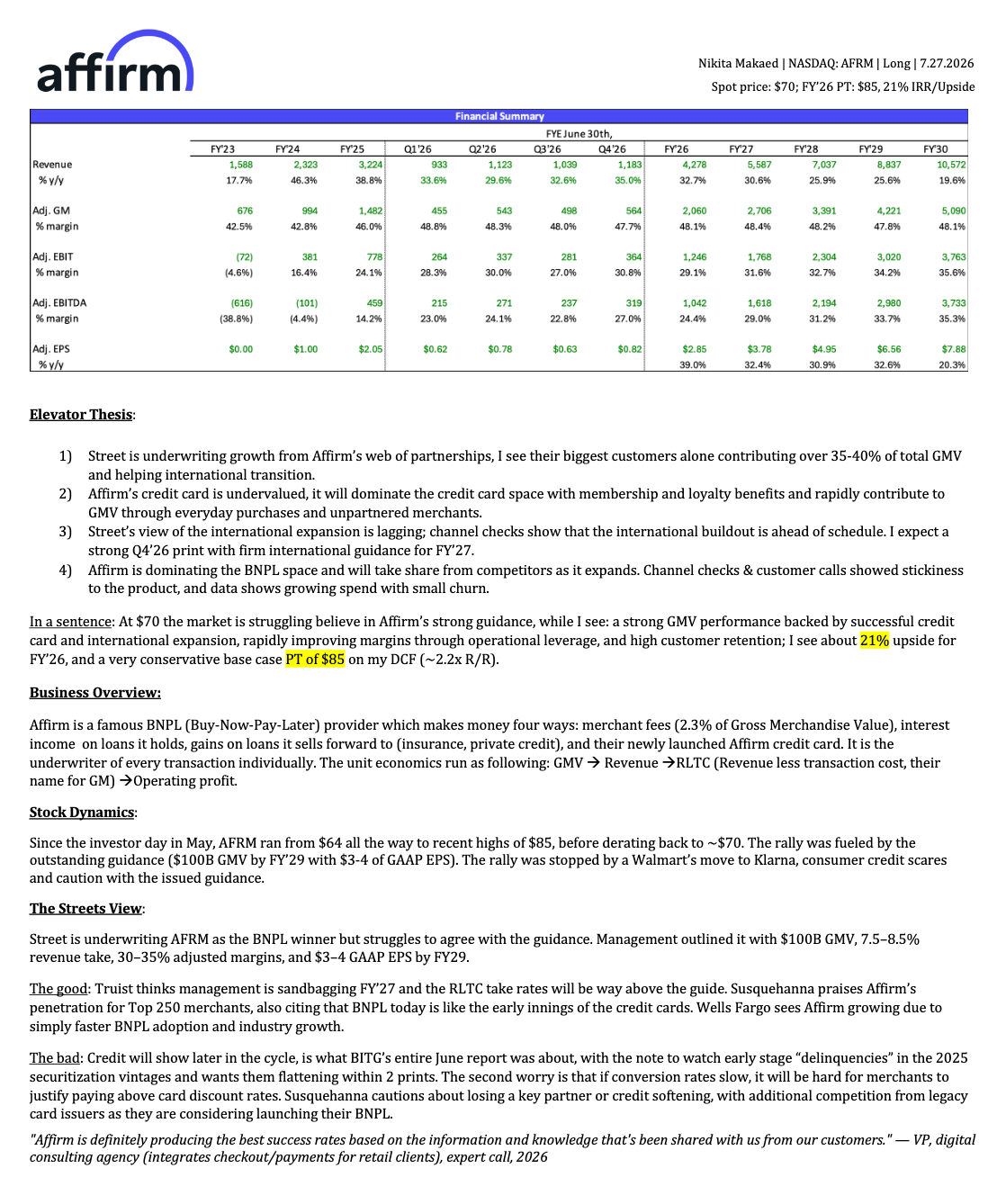
Position: At $70 the market is struggling believe in Affirm’s strong guidance, while I see: a strong GMV performance backed by successful credit card and international expansion, rapidly improving margins through operational leverage, and high customer retention; I see about 21% upside for FY’26, and a very conservative base case PT of $85 on my DCF (~2.2x R/R).
Elevator Thesis
- Street is underwriting growth from Affirm’s web of partnerships, I see their biggest customers alone contributing over 35-40% of total GMV and helping international transition.
- Affirm’s credit card is undervalued, it will dominate the credit card space with membership and loyalty benefits and rapidly contribute to GMV through everyday purchases and unpartnered merchants.
- Street’s view of the international expansion is lagging; channel checks show that the international buildout is ahead of schedule. I expect a strong Q4’26 print with firm international guidance for FY’27.
- Affirm is dominating the BNPL space and will take share from competitors as it expands. Channel checks & customer calls showed stickiness to the product, and data shows growing spend with small churn.
Business Overview
Affirm is a famous BNPL (Buy-Now-Pay-Later) provider which makes money four ways: merchant fees (2.3% of Gross Merchandise Value), interest income on loans it holds, gains on loans it sells forward to (insurance, private credit), and their newly launched Affirm credit card. It is the underwriter of every transaction individually. The unit economics run as following: GMV → Revenue → RLTC (Revenue less transaction cost, their name for GM) → Operating profit.
Stock Dynamics
Since the investor day in May, AFRM ran from $64 all the way to recent highs of $85, before derating back to ~$70. The rally was fueled by the outstanding guidance ($100B GMV by FY’29 with $3-4 of GAAP EPS). The rally was stopped by a Walmart’s move to Klarna, consumer credit scares and caution with the issued guidance.
The Street’s View
Street is underwriting AFRM as the BNPL winner but struggles to agree with the guidance. Management outlined it with $100B GMV, 7.5–8.5% revenue take, 30–35% adjusted margins, and $3–4 GAAP EPS by FY29.
The Good: Truist thinks management is sandbagging FY’27 and the RLTC take rates will be way above the guide. Susquehanna praises Affirm’s penetration for Top 250 merchants, also citing that BNPL today is like the early innings of the credit cards. Wells Fargo sees Affirm growing due to simply faster BNPL adoption and industry growth.
The Bad: Credit will show later in the cycle, is what BITG’s entire June report was about, with the note to watch early stage “delinquencies” in the 2025 securitization vintages and wants them flattening within 2 prints. The second worry is that if conversion rates slow, it will be hard for merchants to justify paying above card discount rates. Susquehanna cautions about losing a key partner or credit softening, with additional competition from legacy card issuers as they are considering launching their BNPL.
“Affirm is definitely producing the best success rates based on the information and knowledge that’s been shared with us from our customers.” — VP, digital consulting agency (integrates checkout/payments for retail clients), expert call, 2026
Debunking The Street
Claim #1: “Merchant pressure on take-rates. If conversion rates slow, we think it will be hard for merchants to justify paying above-card discount rates to Affirm.” — Vincent Caintic, BTIG (June 2026)
The price wasn’t always the reason why they chose Affirm as a payment provider. Every BNPL lists 4-6% + 30¢ charge on every transaction, PayPal is actually the cheapest option. Yet SPI for example takes over 90% of BNPL volume on Shopify. It’s pre-integrated and altogether commanded by Shopify, the stats show that merchants who use it have 1.72x higher conversions, 4x faster checkout, 35% less cart abandonment. Conversions might fall a bit, but it’s by far the best option on the platform.
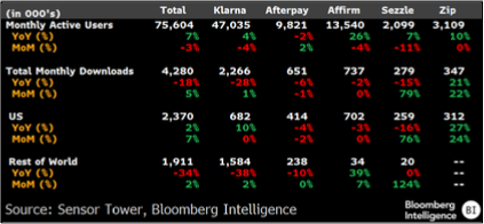
Although Shopify isn’t their whole merchant base, the quality gap shows up in the data that is shown by Bloomberg. Taking Klarna as an example, does have a bigger user base ($118M vs 23M), but Affirm users transact $2,200 a year against Klarna’s $1,080, and monetizes at $185 of revenue per user against Klarna’s $26, which is 7x more. June app data shows Affirm actives up 26% while Klarna’s grew 4% and fell month-over-month as it tightened credit. Even if conversion rates drop to some degree, it’s an advantage to bet on Affirm to bring more business rather than on other BNPLs.
Claim #2: “Downside risk of $40 could be achieved by AFRM losing a key partner…” — Susquehanna (June 2026)
Although the risk is real, there is a big counterargument to it. Letting Walmart go (a top 5 partner) to Klarna/One Pay in March was a strategic move in my opinion. Affirm is transitioning some of their GMV to come from everyday retailer partnerships to direct card purchases. Walmart is accountable for a lot of goods, most of them would never be reserved for APR revenue, but rather merchant fees. As 50% of AFRM’s revenue comes from interest, paying excessive amount for a partnership that can be replaced with their growing card spend is a better option.
It’s important to highlight that as the card spend grows and its active users, Affirm will rely much less on everyday retail partnerships, as it’s going to be accessible through the Affirm card. However, I do acknowledge that losing a high AOV partner like Best Buy would bring much more damage, but management knows that themselves and will do their best to prevent it from happening.
The 4 Drivers of Variance
1) Street is underestimating the growth of Affirm’s web of partnerships and their help for a global expansion.
Qualitatively: Street is not confident that Affirm will show strong movement towards it’s guidance, and to be fair I didn’t believe their GMV guidance myself when I initially sourced the name. Further in my research, channel checks and calculations had me realize that I will be expecting a 5-15% beat on that GMV by FY’29. Here is how we get there:
First, Street is underestimating the web of partnerships Affirm has built over the years. Affirm’s coverage today runs through every layer of US commerce, through installments behind ShopPay, Amazon at checkout, Apple Pay and Google Pay in-wallet, and PSP integrations (Stripe, Adyen, FIS, Fiserv). Altogether 515K active merchants total, up 44% y/y. Being pre-installed and easily accessible through other payment methods like Apple Pay or Google Pay is the moat.
A checkout integrator says that on the expert call: ’They have a lot more integrations and partnerships than a lot of the other companies… it’s much more advantageous for the payment company to be listed on a customer’s website — or easily accessible through fast payment methods.”
Their relationships with businesses continue to be strong: “Merchant churn remains low and rounds down to effectively 0%.” I found that that merchants are now starting to approach affirm, which confirms what management has been saying, they are asking to be integrated into the app before they even go live, to use Affirm’s user base as a marketing channel. Furthermore, Affirm continues to build on that. The app is being redesigned around a deals and customer customization, where merchants fund personalized offers for their target customers. Affirm’s models decide which deals to propose to which customers, based on who is most likely to buy and repay.
The first test of this was 0% Days last fall, which brought 30% incremental GMV for participating merchants with no pull-forward effect. Currently 10,000 merchants are already funding offers in the app. Affirm evolved to a channel that now sends them customers, rather than only connecting.
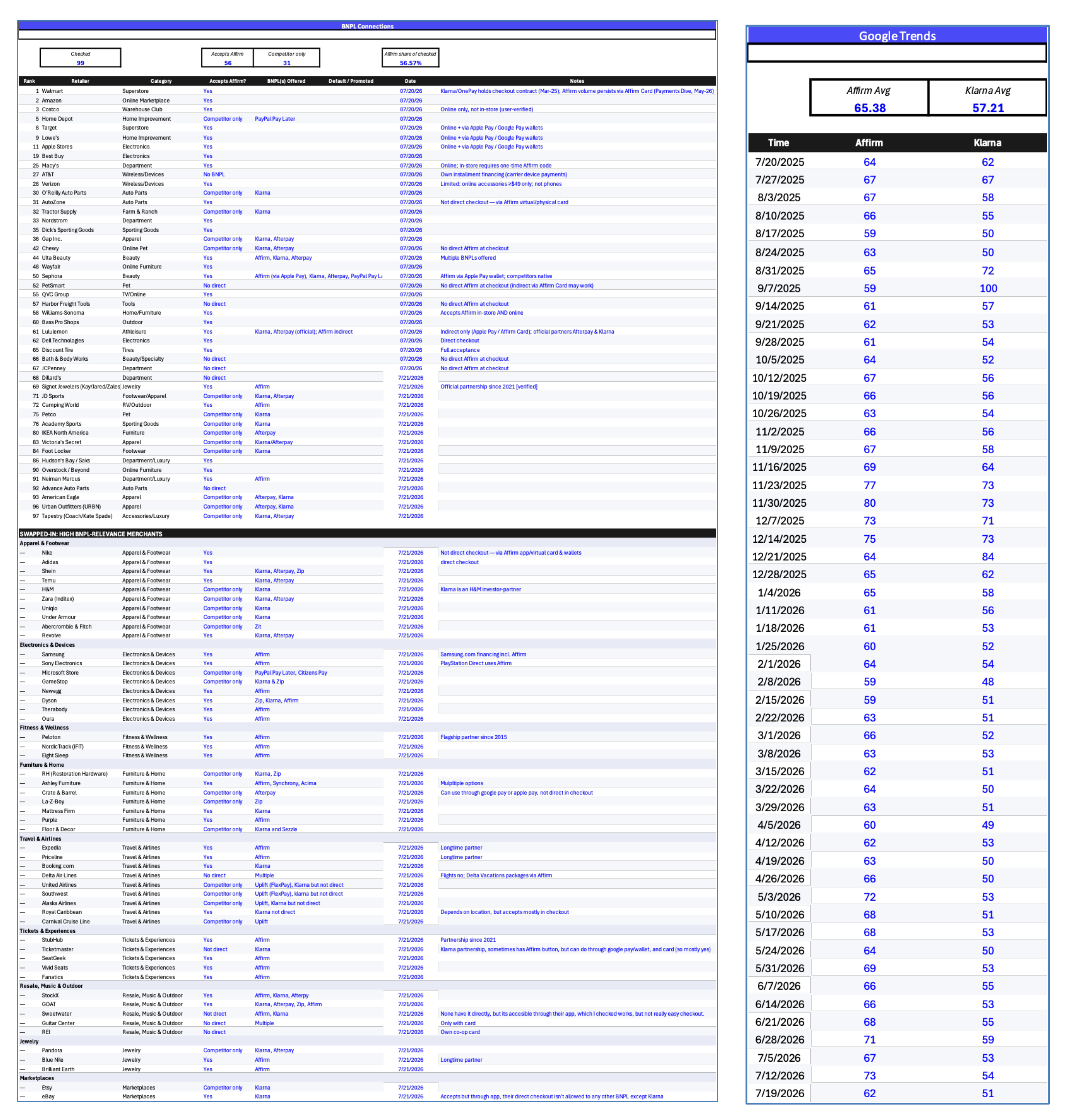
My channel checks confirm their quick growth. Of the top and most popular ~100 US retailers (excl. grocery, gas stations), 57% accept Affirm directly at checkout, and the Affirm Card. 3 Months ago, sell-side were mentioning penetration reports of ~33%, which shows improvement.
Their current model compounds two ways. Existing merchants expand at a 116% average net expansion rate (which means their own stores grow 5-10% plus affirm gains share within them), and affirm adding 157,000 new merchants in the last 12 months. Interestingly enough, Affirm has seen 66% CAGR in adjacent verticals in the last 2 years, which why they are expanding into the ISV channel (Intuit, Houzz, ServiceTitan), that market has a TAM ~8T and is very new to BNPL.
Second, Affirm discloses that their Top 5 merchants together contributed about 44-46% of GMV in the FY’26. Their #1 partner being Amazon at ~20-22% of GMV. After my chat with Investor Relations, I was able to clarify some calculation methods and also find out that their 2nd biggest partner is Shopify (no surprise there). Running some math on Amazon, and then Shopify’s US GMV and Affirm’s 3% capture there, I was able to backout into these numbers below.

Together these giants, contribute about 35% of total GMV, however I expect that number to rise.
Shopify partnership is the one street doesn’t seem to be paying attention to. Affirm is the exclusive payment method behind Shop Pay Installments, renewed till 2030 in May, they are the #1 BNPL provider across their ecosystem, covering 85% of BNPL volume on the platform. It is also the fastest-growing checkout in ecom. Shop Pay MAUs grew 39% y/y which is faster than Cash App, Venmo, PayPal. Their downloads up 118%, led by international growth. And only 180B of Shopify’s GMV is live for SPI today; as DE/FR/AU roll out, Affirm’s addressable market on the platform grows an additional $120-150B at zero acquisition cost.
Amazon is more covered and has been gaining share. Affirm isn’t shown on every eligible purchase yet, so the capture rate is about ~2% of Amazon’s US GMV, but I expect more capture as BNPL industry is rapidly accelerating. I model +30%/yr, which is a deceleration from its previous growth.
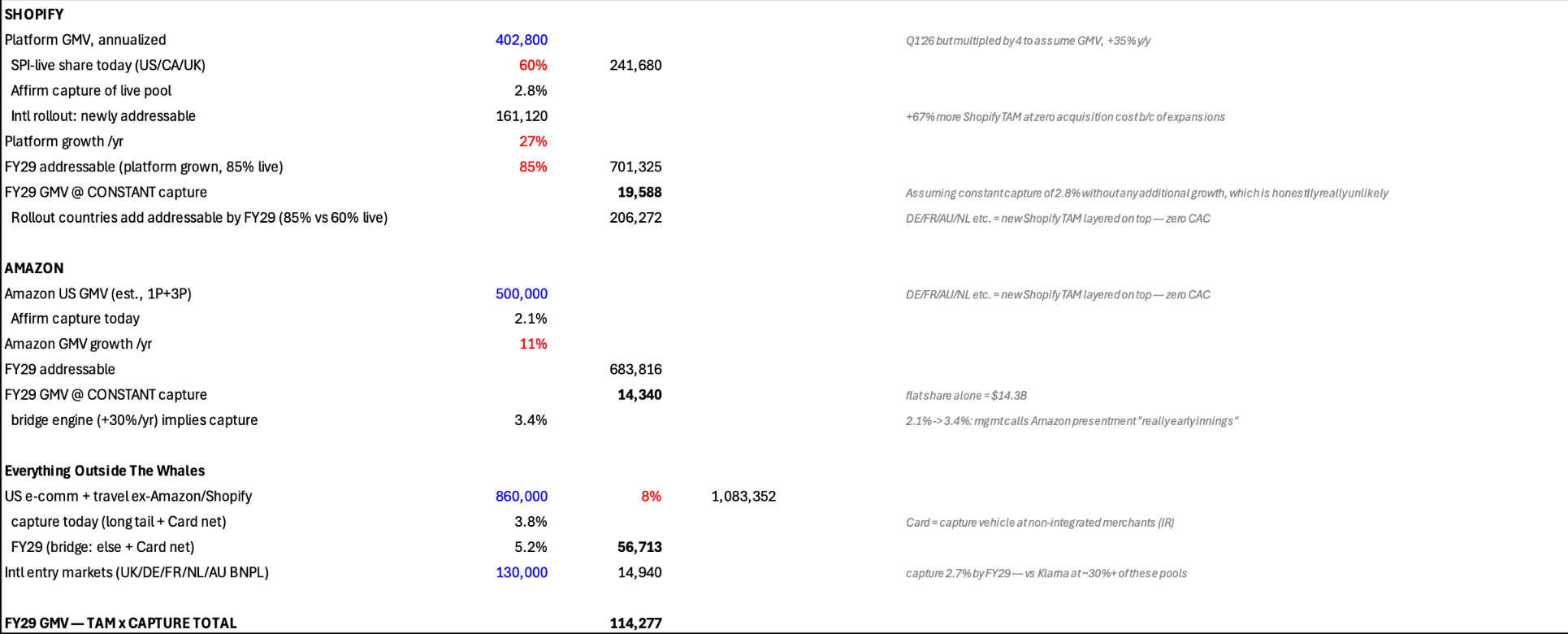
Using these calculations, I get about $114B of GMV by FY’29, higher than the guided $100B and my base case of $104B. We will explore the international GMV later in the memo.
2) Affirm Card will structurally dominate the credit card market and reach unpartnered merchants.
Qualitatively: Street fairly estimates the potential of the card towards GMV, however what it fails to understand is that the card as per Investor Relations is ~80% of the time used at merchants that are not partnered with affirm. Grocery store and most everyday retailers don’t have Affirm, which is exactly where this card is going to kick in.
When talking to sell-side I found out that they viewed it as the growth that’s going to overlap with regular Affirm partners. I expect the 80% number to move to ~90-95%. When I ran customer calls, most people used it for in person shopping and mostly clothing stores. Affirm was never going to partner with grocery stores and small retailers b/c their main source of income is interest rather than merchant fees.
The affirm card is a strategic move to keep charging the fees without directly partnering with retailers. Levchin said it himself: ‘people will actively switch to our card to counterweight the fact that a merchant decides to no longer support Affirm.’“ Because of that, I expect it to contribute 2-5pts of variance towards the guide.
Now that the quantitative part is cleared up, here is why I see the Affirm card being superior to an average credit card provider. The average credit card APR is 21-22% (fed data), store cards run past 30%, and both compound and charge late fees. Affirm’s pay in 4 has no fees, roughly a 1/5 of volume carries 0% APR, and interest loans are fixed, disclosed before you buy and it has no late fees. Consumers love it and see it as a cheaper product, the transactions per active customer are up over 50% YTD.
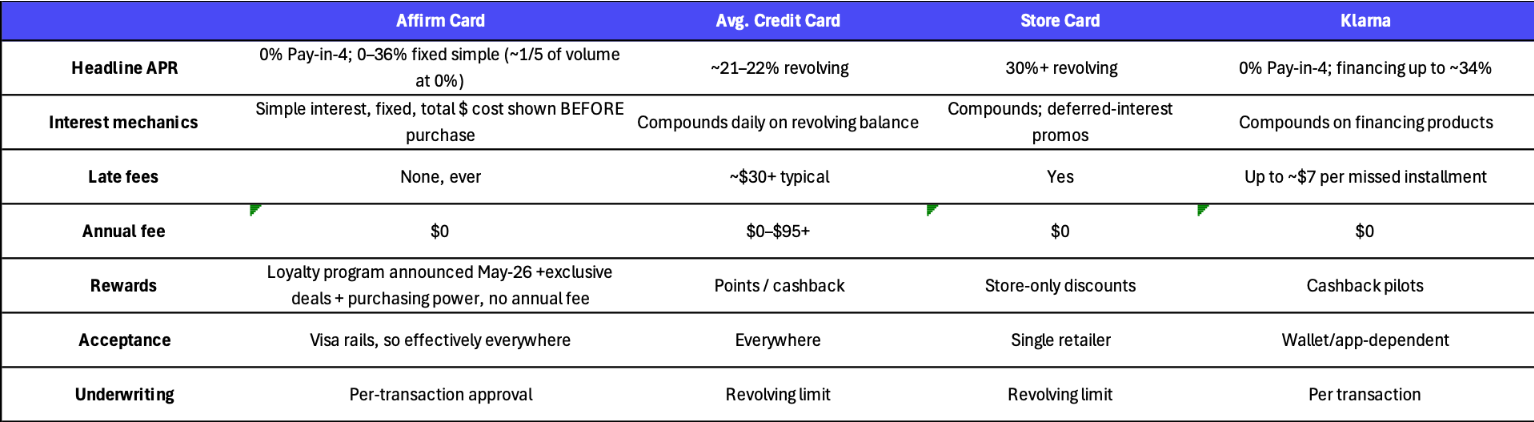
The missing component was rewards, and management showed the layout in May with a complete redesign of the app I mentioned above. Daily merchant offers, 0% or longer terms, personalized by Affirm’s models to each cardholder — plus more purchasing power when you link a bank account, and no annual fee. Merchants pay for the rewards, not Affirm, and I expect launch details and positive commentary on the Q4’26 print.
Worth mentioning is their Affirm Edge, where Affirm is embedded directly into bank apps through FIS and Fiserv, a $140B addressable pool per management. More details to come on that later in the year.
Driver 1: Pricing power has hit a ceiling
Qualitatively: Street models assume continued pricing power through FY27–28, citing the successful 2024–25 price hikes as evidence that current and future increases will stick. The Street expects price increases in North America and Europe to keep ARPU high and protect it from geographic mix-shift; rest-of-world ARPU is approximately one-third of North American ARPU.
Channel checks: Our 261-respondent survey of paid users in the United States and Canada, conducted through Prolific, produced 256 valid completes. It indicates that pricing power is structurally exhausted at $12.99.
Half of respondents questioned the latest price hike and were considering switching—or had already switched. We estimate that churn in the coming quarter will be approximately 50 basis points above Street expectations and remain at least 30 basis points above expectations for the rest of the year.
Retention may be manageable, but acquisition is a larger problem when competitors offer subscriptions at approximately a 15% monthly discount. Spotify may not convert free users at the previous rate while churn remains elevated. Even if rest-of-world growth makes up for missing Premium conversions in mature regions, ARPU will suffer from geographic mix.
Another price hike this year or early next year could create significant backlash. Our poll suggests churn could be 25% higher, adding another 85 basis points of monthly churn. We therefore see further near-term price increases as unlikely and future ARPU dilution as difficult to avoid.
3) Street is behind on the timing of the international ewhat txpansion + believes 1-5pt GMV soft guidance.
Quantitively: Affirm’s guide implies about $100B GMV by FY’29, of which as per management “1-5pt GMV will come from the international expansion.” Running the math à $1-5B GMV by FY’29.
Although I was unable to clarify the exact calculation of overseas GMV guide, and whether that included their international partners – I am confident that their guide implies businesses outside of the giants such as Amazon, Shopify, etc. Affirm has scaled 30B of GMV in the last 3 years in the US, 2.5x, 35% a year, and today it isn’t the same FY’23 brand. It has more partners, bigger trusted user base, near universal acceptance for their card.
Per investor presentation, 72% of Affirm’s Top 50 merchants already operate internationally and have been pushing them for a global expansion. The UK launch itself came through Shopify, announced together on April 2025, live November 2025, on schedule.
The UK segment went live (more demo pretty much) and already has estimates of around 400M GMV so far. My channel checks show rapid hiring, with the Netherlands team fully assembled with an MD in seat and engineers still being hired. Over 180 employees in Poland, 136 in Spain and a starting team in Australia, France & Germany. They are fast on schedule, and I expect them to announce a strong positive guidance for FY’27 across the globe.

To get more in detail, I’ve constructed a TAM build below, for the countries that Affirm is expanding to. In order to get the exact amount of Ecom without partnered merchants like Amazon & Shopify, I subtract them assuming 20% flowthrough. After all calculations we get an addressable market of ~$149B. At a 10% capture rate, we get about ~14B worth of GMV by FY’29.

What I expect from here: strong international guidance for the FY’27 during the Q4’26 print, progress reports on all segments with exact launch schedules all coming within the first half a year.
4) Affirm is the best product in BNPL, customers and merchants both stay, and it will take share as it expands.
Qualitatively: Every channel I ran ended up in a similar conclusion. My reddit cohort (100 post), although always skewed to be slightly negative as people tend to post on reddit mainly to complain, helps me and shows that people have various issues about Affirm. However, they end up using it anyway, it has a retention rate of 83% of complainers and my own customer calls and expert calls confirm it.
“I think they’re the market leader objectively within the space… our money would be on Affirm because it has the best possible product as of now” (VP, digital consultancy).
When running own channel checks where I live in Florida. Two things stood out. First, awareness is still early, because only about one in ten people I talked to had even heard of Affirm. Second, people who use the product, said it is sticky because everything is upfront. They know the total cost before they buy, and there are no fees if a payment slips, which makes them feel safer than buying on a credit card.
On Klarna, answers split between “no preference” and preferring Affirm for exactly that transparency (Klarna has late fees). This also matched with my Reddit cohort. In summary the common theme was that “I have my concerns, but they’re the best out there, and I still need the loan, so I’m going to use them.”
Quantitatively: an Affirm user transacts $2,200/yr vs Klarna’s $1,080 and produces ~$185 of revenue vs ~$26. That’s a 7x monetization on a smaller, deeper base. June alt-data showed Affirm actives +26% vs category +7%, and Klarna +4% and shrinking month-over-month.
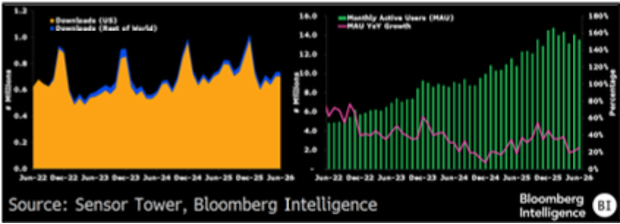
June app data: Affirm actives +26% vs category +7%, Klarna +4%. However, Klarna is shrinking 7% MoM in Australia and the UK, the exact markets Affirm is entering. It also showed stickiness as the churn ran roughly 1% in June even as actives grew 26%.
Affirm is also ahead on the AI race and is superior with their models. It has 186B training data points, each model generation approving +12–15pp more borrowers at fixed delinquency rates, which BTIG has worries about. ABS losses tracking at or below pricing across all five shelves including the 2025 vintages, and funding spreads compressed from 300bps to 100bps. That is the best signal that credit investors trust Affirm, due to that I see funding costs continue to decline over time (part of GM).
The same model runs the offerings, that’s what merchants are looking for this year. BoostAI decides which deals shoppers see, and decides approvals for them and live tests show 5–15% GMV uplift at existing stores. Mentioned in thesis #1, Affirm edge will also not only provide additional GMV usage, but once users link their bank accounts, underwrites off your cash flow, so purchasing power grows with behavior (more consistent purchasing power), which is what user have been complaining about.
Klarna as for most direct competitor is my “control group,” had tightening credit, worse model performance with a much higher user base and experience. Furthermore, they are losing the fight with agentic checkout, Affirm claimed Google’s Gemini agentic checkout & partnership with Stripe. Due to lack of data, I can’t provide an exact uplift for these 2 partnerships, so I leave them out of my base case, as an additional upside.
Current Margin Story
Deep diving into my calculations and the guided framework: revenue at 7.5–8.5% of GMV, RLTC at 3.75–4.0% of GMV, adjusted operating margins of 30–35%, and $3–4 of GAAP EPS by FY’29. Here’s where my model sits on each line and why.
- I project revenue at 8.6% of GMV this year fading to 8.3-8.4% by FY’29, which is the top of the guided range, but declining. The fade is explained by the 0% APR Mix and Pay in 4 carry lower revenue take, an the CFO has gided softening, recent actuals run 8.6-9.0%, so my fade is somewhat conservative, I see them beating on volume rather than take rates.
- RLTC is their gross margin, in which I model compression. RLTC glides from 4.13% to about 4.0% by FY’29. The card is the primary reason, more transactions and processing cost per dollar, 0% mix lifts the loan but offset by funding improvement. ABS spread already compressed by 200bps, I see some marginal improvements there still.
- Moving onto EBIT, we have Technology up first. Grows ~20% per year fading 0.5-1pts yearly, the trick is the operating leverage. Tech spend grows 17–20% a year against revenue growing ~30%, so tech cost fall. Management is explicit that headcount stays roughly flat with AI carrying engineering productivity. My growth rate covers wage inflation and bonuses (5-8% together) plus a hiring cushion.
- Sales & Marketing is tricky; I see no substantial improvement. However, the reason why marketing gets an uplift is because enterprise warrant amortization declines over time and has been shrinking significantly. I expect actual marketing costs remain about the same as I consider it vital to international expansion.
- G&A is the last improvement growing at an average of 6-7% a year, which is higher than it has done historically to give myself some cushion. It falls from ~13% of revenue toward ~7% by FY’30.
This lands me upper-mid of the guide at 33.9% adj FY’29 (22% GAAP). One note worth mentioning is their NOLs, with my calculations and schedule, Affirm’s tax rate will result in my base case projections in order from FY’26 to FY’29, 2.1% → 3.6% → 4.2% → 14.0% → 21.0%.
Valuation & Risk/Reward
For my valuation I am using a 10-year DCF combined with a FY’26 PT using P/E.
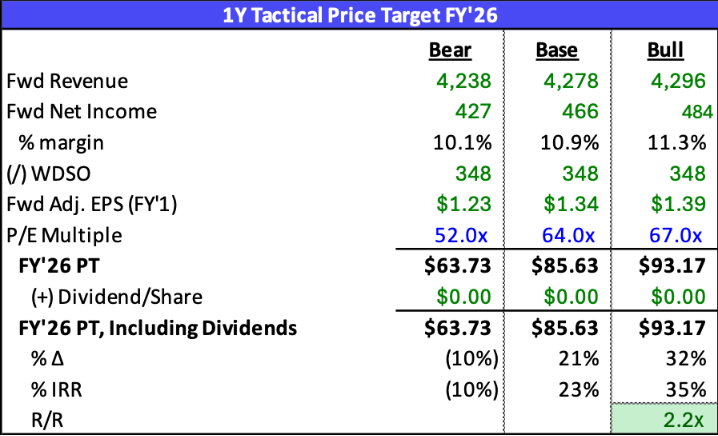
For my DCF my PTs are as following (Bear ,Base ,Bull): $52, $85, $97. The bear is not a normal downside case as it assumes worst possible scenario for Affirm where it misses every element of its guidance. Important to note, that I have been very conservative and fair within their improvements and numbers as I would rather have unexpected upside, rather than unexpected downside.
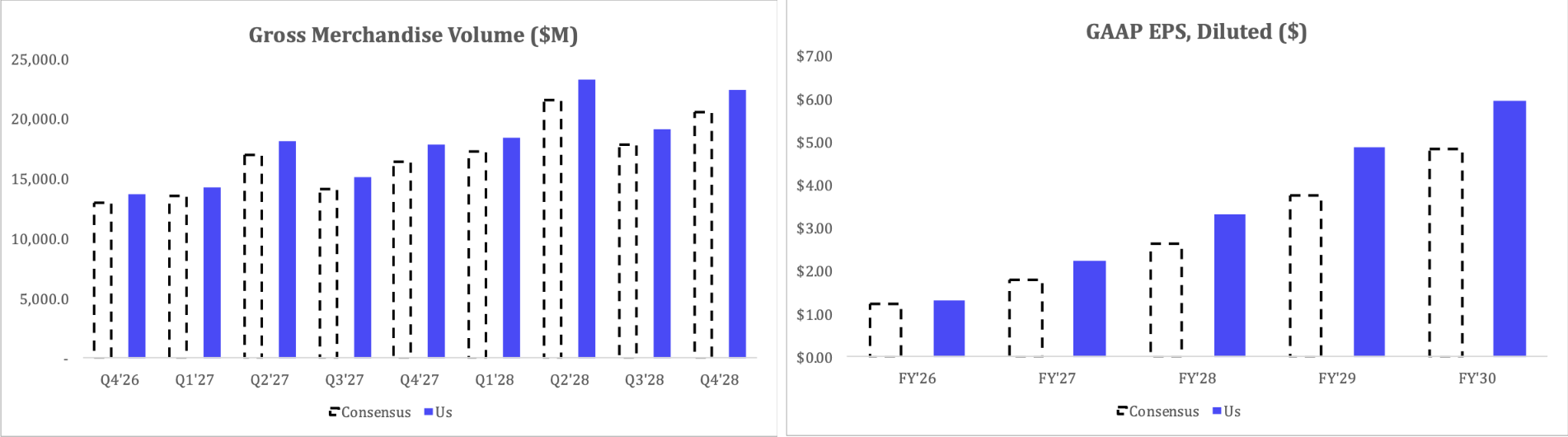
If I instead run my TAM based GMV numbers (the realistic international capture and bridge engines at current pace), base and bull lift another $10–15 per share. I intentionally don’t include that as I would rather be conservative.
Regarding my FY’26 PT, I expect 2.2x R/R scenario. With stock missing it’s earnings and derating to about 50x times, with my bull case trading up 3x flips, to 67 times earnings.
Risk
1) Credit deteriorates and the 2025-vintage delinquencies keep rising into a softer consumer.
a) Mitigant: The book turns over ~3x a year and every transaction is underwritten individually, so they have some flexibility and will be able to give out tighter loans. That’s one of the only risks that you cannot directly control.
b) Mitigant: Alternatively, you can isolate Affirm’s performance vs other BNPLs and sub out the macro environment, you can pair trade this leg → Long AFRM / Short KLAR.
2) Partner risk in which Amazon renegotiates from strength, or loses major partners.
a) Mitigant: Walmart, a top-five partner, left for Klarna/OnePay in March 2025 in which Affirm kept the volume through the Card and accelerated to 35% growth the following year.
b) Mitigant: Best assumption for Amazon is that it has partnered with Affirm for a while, they have the best conversion rates in the industry and it would be a risk to take on another BNPL, therefore I see Affirm with major power in negotiation over other BNPLs.
3) Major card issuers launch their own BNPL plans, a risk to the Card and to the checkout business at once.
a) Mitigant: The installment plans already exist and have for years, for example, Amex Plan It (2017), My Chase Plan (2019), Citi Flex Pay and BNPL grew 30%+ a year regardless and not through them. It really isn’t the same as the regular BNPL providers and don’t have nearly the same network that Affirm has grown, they will not be willing to take on further default risk.
b) Mitigant: Issuers will have a tough time replicating the network Affirm has created. The custom pricing, AI features, deals with major partners. It will take years, by which then Affirm will prove even higher conversions and will become a global brand.
Catalysts and Path to Getting Paid:
1. Q4’26 Earnings Print (Late August) + International Guidance
The single highest-value disclosure of the year, I expect the numbers to remain above sell-side estimates. There have been worries of sandbagging as well, however I am confident they will print massive margin improvements and most importantly what street will be looking for is the progress on global expansion and strong guidance on other card features, BoostAI and Affirm Edge.
2. AI remixing becomes a paid product with clean economics
Daily merchant-funded personalized deals, more purchasing power with bank account underwriting, no annual fee will easily pop the stock. Further news and commentary on conversion using AI and improved models will continue to re-rate the stock higher.
3. Advertising reaccelerates faster than modeled
So far Affirm has announced in concrete expansion into UK, Netherlands, France, Australia, Germany. However not Poland nor Spain, but we do see hiring from those locations and might be more to come. If more territories get announced I expect an significant rally, as it will imply successful beginnings in other locations.
4. Positive macro environment
Affirm is most definitely correlated with the current macro environment. It is influenced by inflation, rather than rates (but each obviously follows each other). Early stage delinquencies is likely a market worry now, and as they continue to flatten and positive macro continues it will reinforce the positive market sentiment.
Most importantly, this is the name that I am confident to hold with short-term and long-term horizon, where the path to getting paid is visible from both standpoints, which is a big indicator for me that this business is a Long.
Appendix
Figure #1: General Information
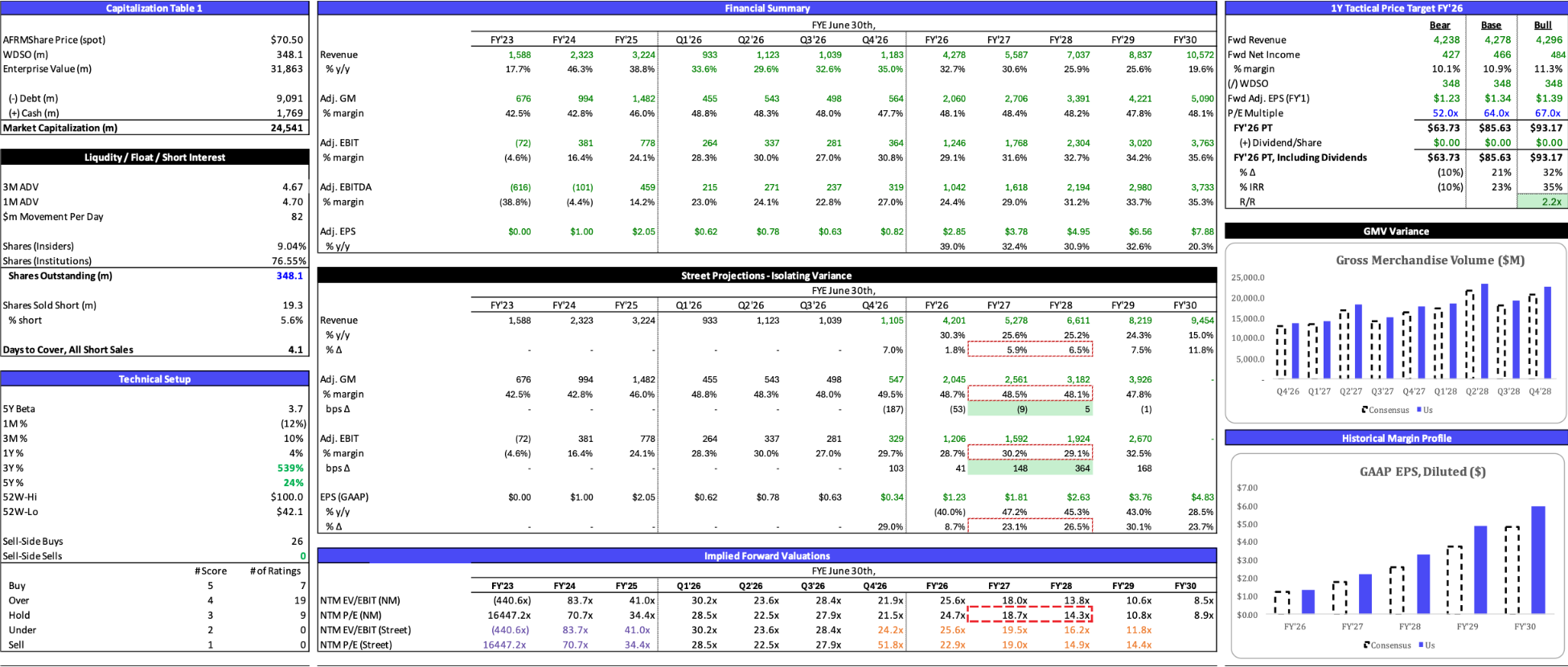
Figure #2: Sizing & Risk Reward
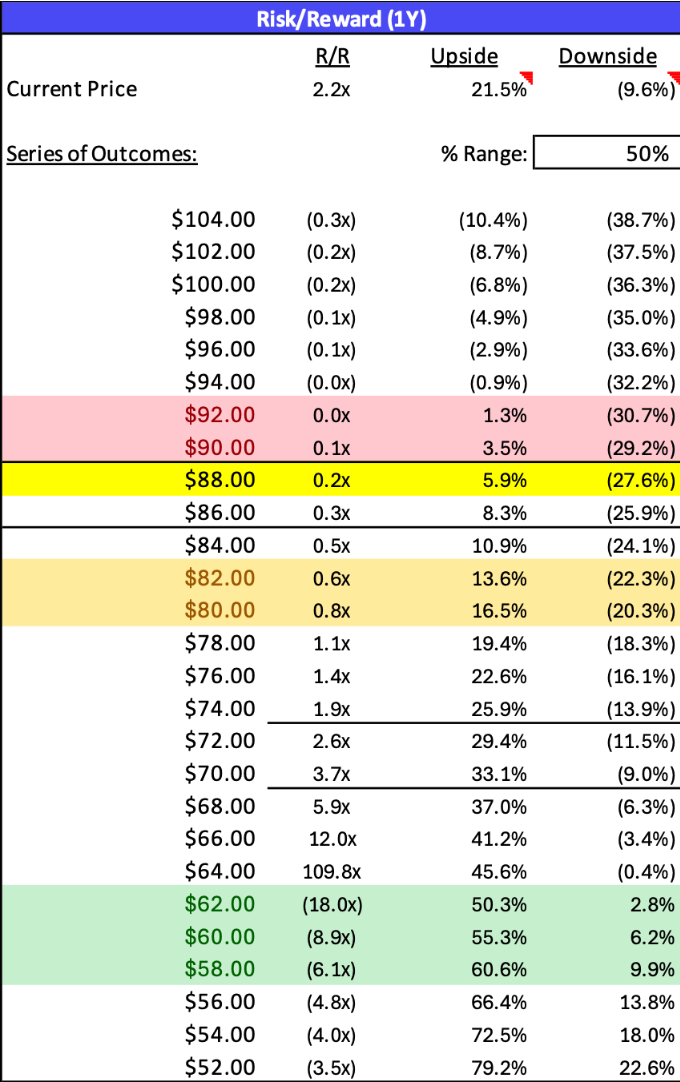
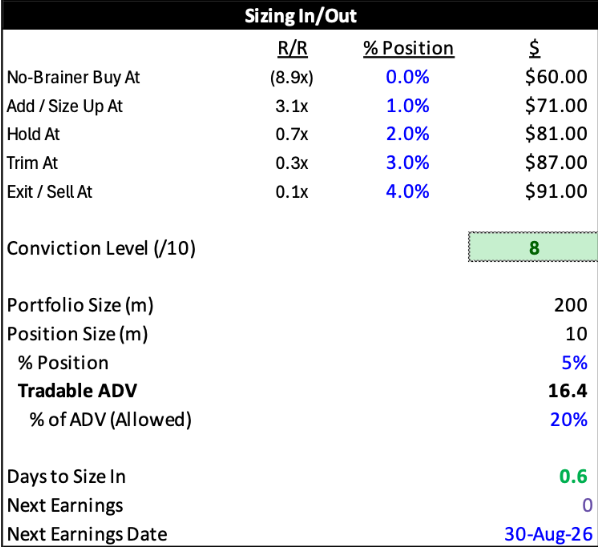
Figure #3: Valuation
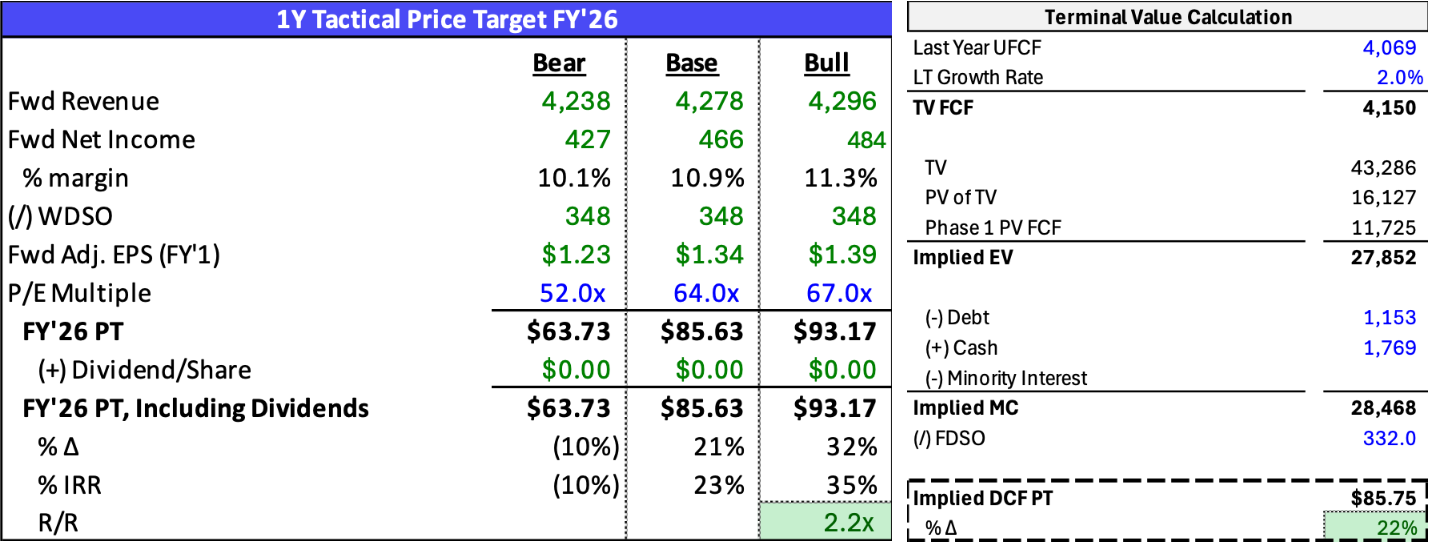
Figure #4: Variance to Street
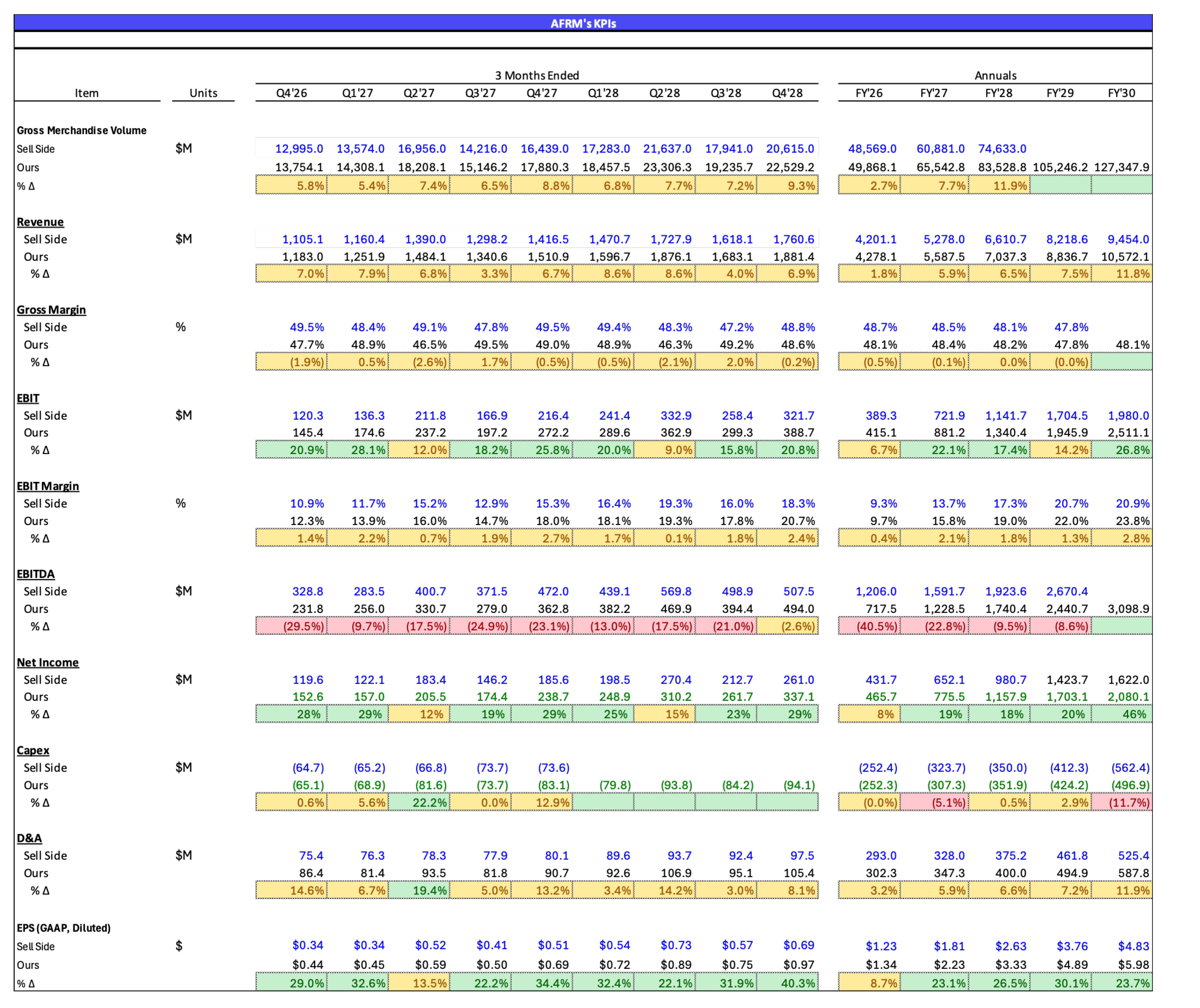
Figure #5: Additional GMV Calculations
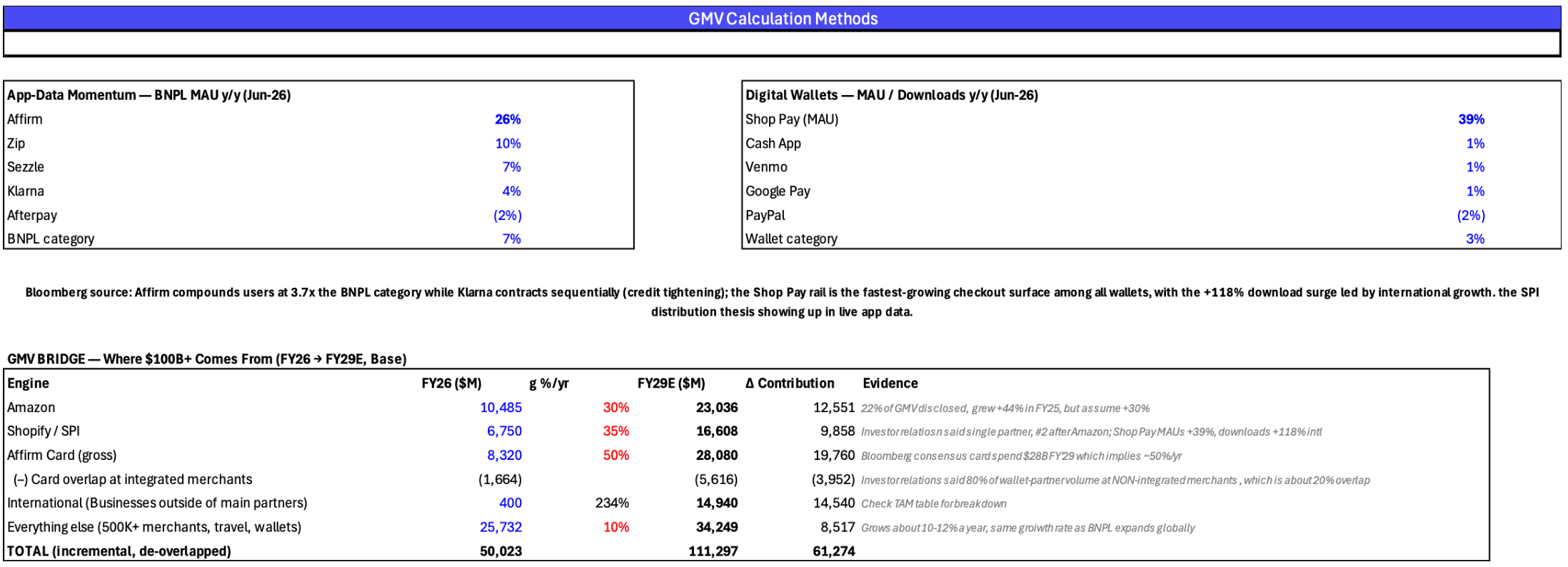
Figure #6: Additional Channel Checks
Original Research Memo
Click here to view the original PDF.
Disclosures & Certification
Analyst Certification
Each author of this report certifies that (1) the views expressed herein accurately reflect his or her personal views about the subject company and its securities, and (2) no part of any author’s compensation was, is, or will be related, directly or indirectly, to the specific recommendations or views expressed in this report. SCM analysts are students and receive no compensation of any kind for research.
SCM rating system
LONG, expected to outperform the S&P 500 on a total-return basis over the stated horizon. SHORT, expected to underperform the S&P 500 over the stated horizon.
Important Disclosures
Stern Capital Management (“SCM”) is a student organization at the NYU Stern School of Business. This report was prepared by students for educational purposes only. It is not investment advice, an offer, or a solicitation to buy or sell any security, and it has not been reviewed or approved by New York University or NYU Stern. The views expressed are solely those of the student authors. Nothing herein constitutes a personal recommendation or takes into account any reader’s objectives or financial situation.
Information is drawn from public sources believed to be reliable — company filings, transcripts, press releases, and market data providers — but SCM does not guarantee its accuracy or completeness. Estimates and price targets reflect the authors’ judgment as of the report date and are subject to change without notice. Past performance is not indicative of future results.