
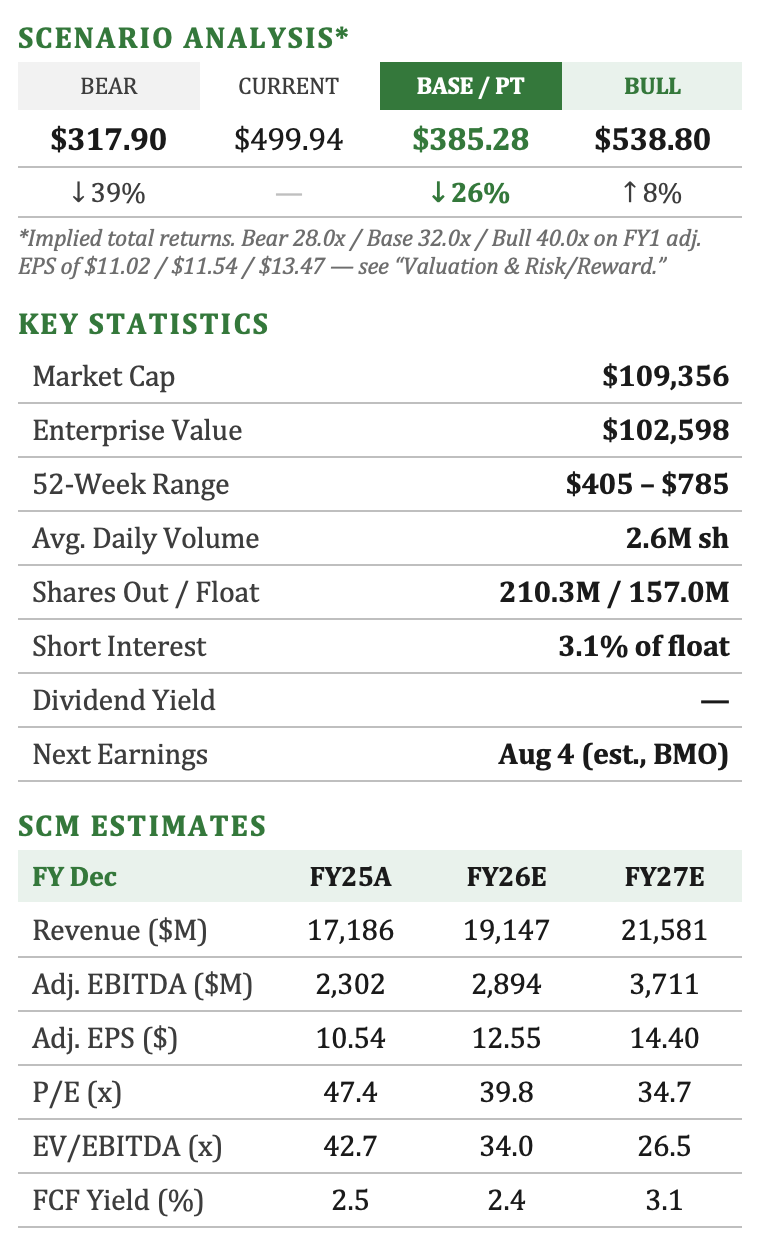
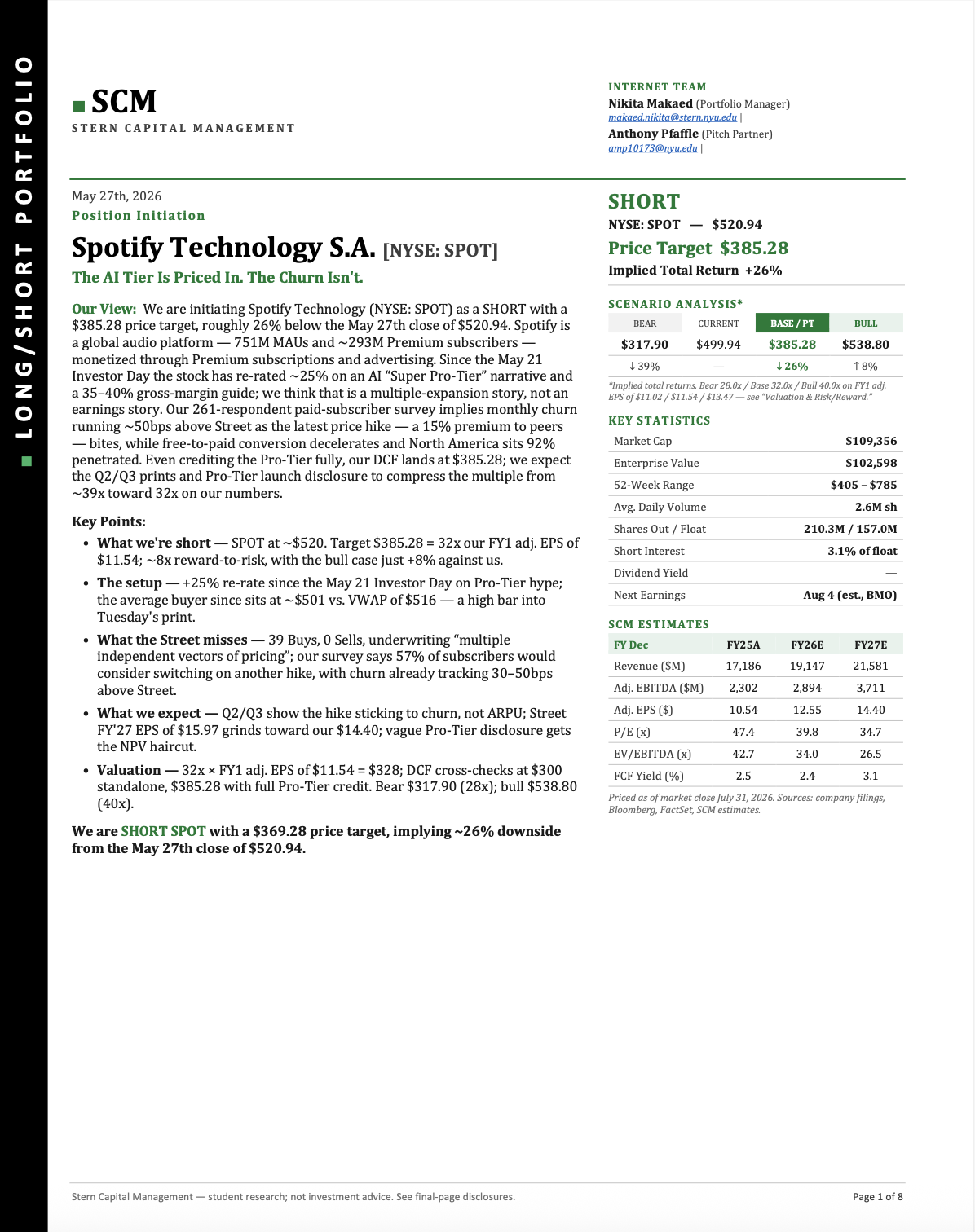
Position: We are SHORT SPOT with a $369.28 price target, implying ~26% downside from the May 27th close of $520.94.
Elevator Thesis
- Spotify’s recent Q1 price hike positions their subscription cost at a 15% premium to peers, with already Q1’26 premium adoption decelerating, our survey of US paid users implies a further ~50bps in monthly churn compared to street estimates.
- The Street is underwriting a “trust me” story with management’s ability to deliver 40% gross margins through Super Tier Adoption. As music becomes commoditized and mature markets saturate, we believe declining free to paid conversion will lead to higher margin compression than consensus.
- The long-term cash flows generated by the Super Pro-Tier are currently mispriced in the tape. At 17.5% of addressable premium users and our adoption rate of 13% by 2030, Spotify will de-rate by ~24%. We see the new tier as an AI “hail mary” to inflate the multiple through price hikes as opposed to underlying user growth.
Key points
- What we’re short — SPOT at ~$520. Target $385.28 = 32x our FY1 adj. EPS of $11.54; ~8x reward-to-risk, with the bull case just +8% against us.
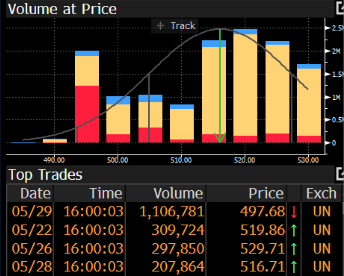
- The setup — +25% re-rate since the May 21 Investor Day on Pro-Tier hype; the average buyer since sits at ~$501 vs. VWAP of $516 — a high bar into Tuesday’s print.
- What the Street misses — 39 Buys, 0 Sells, underwriting “multiple independent vectors of pricing”; our survey says 57% of subscribers would consider switching on another hike, with churn already tracking 30–50bps above Street.
- What we expect — Q2/Q3 show the hike sticking to churn, not ARPU; Street FY’27 EPS of $15.97 grinds toward our $14.40; vague Pro-Tier disclosure gets the NPV haircut.
- Valuation — 32x × FY1 adj. EPS of $11.54 = $328; DCF cross-checks at $300 standalone, $385.28 with full Pro-Tier credit. Bear $317.90 (28x); bull $538.80 (40x).
In a sentence: An “AI tier” growth narrative drove multiple expansion despite decelerating free-to-paid conversion, accelerating price-hike churn, and a mispriced Super Pro-Tier NPV. We see approximately 30% downside.
Business Overview
Spotify is a global audio distribution platform with 751M MAUs and 290M Premium subscribers across developed and emerging markets. The company makes money mainly through Premium subscriptions, where users pay monthly for ad-free listening, downloads, on-demand playback, and higher audio quality, and through advertising, where brands pay to reach free users through audio, video, display, and podcast ads.
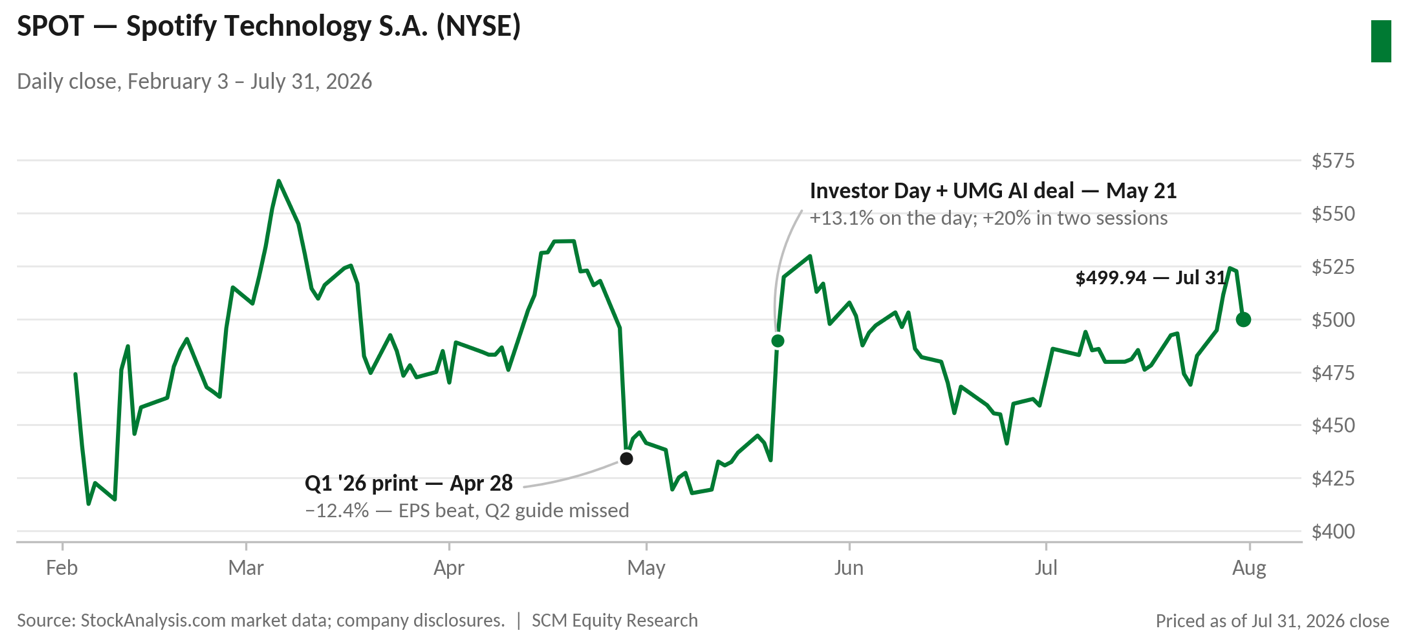
Since the Investor Day, Spotify has traded up approximately 25%. Management highlighted two ideas: a new Pro Tier that would give “super fans” access to new AI features, and gross-margin guidance of 35–40% through FY30.
The Street View
Street is underwriting SPOT as a cleaner compounder post Investor Day. The guide gave a tangible bridge to “mid-teens” revenue growth, “35–40%” gross margin, and “20%+ operating margins.” The bull case is that Spotify now has more ways to beat add-ons, AI music, Marketplace, biddable ads, and buybacks.
The good: ARPU should have more layers. Barclays calls it “multiple independent vectors of pricing.” DB says SPOT can monetize “super-users with higher engagement and willingness to pay.” Upside increases in the attachments: audiobooks, AI remix, podcast memberships, ticketing, and higher usage tiers. If attach flow through kicks in this year, then premium ARPU is understated.
The bad: A lot of this is still theory. Add-ons need real attach. AI needs inference costs and label splits to stay contained. Marketplace and ads need to be big enough to matter. The taste graph moat needs to show up in churn and pricing, not just product narrative. It seems like management is throwing everything at the kitchen sink to find a path to monetization.
A former Senior Business Intelligence Analyst at Spotify says, “The thesis out there that Spotify’s a little saturated is, from my experience, somewhat valid. Spotify has had to look internationally for a lot of growth and that’s meant redoing the free plan and finding other ways to monetize that, etc. It’s hard for me to say right now off the top of my head if there’s necessarily a specific advantage.”
Debunking the Street: Drivers of Variance
Claim #1: “Premium User growth will remain in line, reflecting pricing power in the industry.”
The sentiment towards the price hike has been so far positive both from management and the street. However, we see this as a obstacle towards their premium user growth. In an industry with little-to-zero switching costs and increasing competition, we struggle to see Spotify as the ultimately even in mature regions.
Looking this from a different angle, markets like North American and Europe – who has been historically the highest contributors of revenue – are getting much more saturated. This leaves Spotify’s growth to rely on international markets that are dominated by piracy and other low-cost service providers.
The expert calls confirm this sentiment, “I think the industry, the land grab phase is over. It has been for a while now. At this point you’re trying to capture kids that are getting their first subscriptions. You are looking at global growth into {new} markets where your pricing power is way lower.”

Furthermore, a saturating North American market isn’t just a cap on growth, but also serves as a an inherent risk to their premium base. Currently Spotify is serving 58% of paid subscribers in the Canada and United States, with only about a further 3.5% of more paid users to capture, there is a high inherent risk of churn. This isn’t a forward-looking concern — it’s already showing up in the print, Spotify y/y numbers have been decreasing for the last 3 years, but Q1’26 shows a much faster deceleration than we expected from a so called “dominant platform.” Customers subscribe to Spotify because of their magnificent app & user interface and conviniency of the app, but as competitors (Apple Music, Youtube Music) got progressively better with their products, Spotify hiked price and added more AI feautres that at the end of the day most don’t use.
Diligence call on a customers provided the clarity, “I don’t use 90% of the add-ons Spotify has added in the last year, ocasionally a transition feature into songs, but at the end of the day I am there for the accessibility and music, it’s getting much harder to justify a higher price for me.”
Claim #2: “ARPU compounds as users stack multiple add-ons, potentially exceeding what a single tier would capture.”
The Street assumes these new features such as AI remixes, Audiobooks Plus, and Reserved Ticketing will be margin-accretive in the near term. This is not only Spotify’s first attempt at experimenting with monetizable AI subscriptions, but the Super Pro-Tier will be a drastic change in the consumer subscription industry all together. Music is a fixed product that is sold across multiple streaming services, and each distribution format is tailored in almost identical ways. This leaves the user’s incremental willingness to pay uncertain.
All of these add Ons require higher compute costs and licensing agreement expenses, which may not drive a lift in conversion rates. Consequently, these new features may compress margins near term which is why we do not believe Spotify deserves the post-investor day multiple, especially when there are no prior comps to justify the pro tier revenue acceleration that the Street is modeling.
Bulls argue that AI features will benefit from Spotify’s user data flywheel; however, consumer internet companies have recently struggled to roll out successful AI features. Pinterest, Roblox, and Snapchat all have tons of user data, but when it comes to monetizing this catalog, the data-moat is not enough to push the needle for users to spend more.

Our paid poll that consisted of over 250 participants, showed that only 16% of people care about the tech features Spotify offers to it’s premium users, where for the rest is the familiarity of the app and the simple interface everyone can use. Assuming a 17.5% of premium users are so called “Superfans,” a generous delta of $6 to the regular tier and a 13% adoption rate that gives us implied $3,664m of additional annual revenue during FY’30. With the current projections of this tier, our DCF still implies a 24% downside. (Note: $6 delta is generous, and assuming ROW, Europe & LATAM Pro-Tier have lower delta to premium, a simple mix-shift to $4 increases the downside by an additional ~5%).
Additionally, we assume a 40% incremental gross margin coming from the Pro-tier revenue segment, it’s a very conservative assumption as there is no concrete number to what royalty and music costs could add up to. For example, on a standard bases, music streaming royalty is ~75% to labels. If labels successfully claim incremental royalty, we could the incremental GM tank to 20-25% for that segment alone.
The Two Drivers of Variance
Driver 1: Pricing Power Has Hit a Ceiling
Qualitatively: Street models Spotify as having continued pricing power through FY’27-28, citing the successful 2024-25 hikes as evidence current hikes will stick, and so will the future ones. Street assumes ARPU growth through implementing price hikes in highest earnings regions (aka NA & Europe), which will keep ARPU high, protecting it from the geographical-mix shift (RoW ARPU is ~3 times lower than NA).
Channel checks: Our 261-respondent paid-survey of US & Canada paid users (conducted via Prolific, n=256 valid completes, paid Spotify subscribers) shows pricing power is structurally exhausted at $12.99:

If you haven’t noticed yet, Spotify sits in a domino-like situation. With 50% of people questioning the validity of the current price hike & considering switching (or already are), we estimate that the churn rate for the coming quarter is ~50bps higher than what street expects and will remain at a delta of at least ~30bps for the rest of the year, meaning more users will churn away as the price hike settles down.
Churn rate isn’t the biggest problem Spotify has, keeping users could be somewhat manageable with proper strategies, however acquiring new ones is a problem, especially when competitors are sitting at a 15% monthly discount. Because Spotify will not be able to convert free users at the same rate as before due to the elevated price, while churn rate remains elevated, we see them meaningfully decline Premium User growth further. This creates a domino effect on ARPU, as Spotify grows at mid-single digits in NA and other region price hike regions, this means that even if RoW can make up for the missed premium conversions, ARPU will take a significant hit.
Lastly, even if Spotify wanted to hike prices again this year or beginning of next year, it would cause significant backlash, where our poll shows that churn could be 25% higher, resulting in another gain of 85bps of monthly churn. it’s a suicide mission that Spotify would not take on, which means that ARPU dilution is unavoidable in the future.
Driver 2: The Super Pro-Tier is an AI “Hail Mary”
Qualitatively: Since the Super Pro-Tier has been introduced in the investor day the stock has re-rated over $100 (~24%), the Street is underwriting the Super Pro-Tier as a transformative ARPU lever. Deutsche Bank modeling €1B-€4B in incremental revenue and gross margin reaching anywhere from 37.5-42.5%. The Pro Tier is the single largest “growth narrative” that has popped the stock up since, the catch is that Spotify didn’t deserve the price it was trading at before and it doesn’t deserve the current price when taking into the account the long term cashflows the Pro-Tier can produce.
Quantitatively: As we already mentioned earlier, we estimate that only 17.5% of people truly care about their new AI and tech features, we decided to model out what the adoption would look like for the next 5 years.
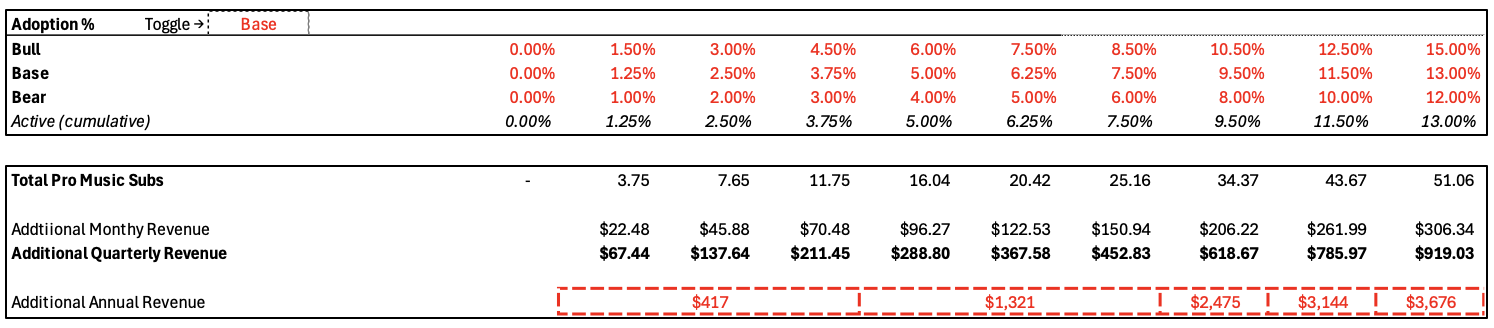
At our projected rates we see anywhere from 3.4B-4.2B in recurring annual revenue by FY’30. With an incremental gross margin of ~40%, we get to an implied value of $401 on our DCF (base case). With, our most bull adoption rates and revenue projections we get a fair value of ~$480, which is still lower than the current price of $420. Now, our goal was to give this new Pro-tier, a much higher benefit of the doubt and be more than fair for all projections, to truly see what long term value it can produce, however it’s important to mention that there is a lot of things that can go wrong which is why we are going to discuss the sensitivity analysis that can de-rate the stock much further.
Sensitivity Analysis
-
Bloomberg Intelligence explicitly models regional pricing at $6/$4/$3/$1 vs. our flat $6. Because the adoption might differ a across regions, and mature regions might find it not as compelling, but RoW adopts fast at the lower Bloomberg pricing, then Spotify will be forced into given price elasticity. A simple drop to delta of $4 to the premium tier adds about 5% to our downside.
-
Adoption curve is more “Hail Mary” than “S-curve”: Spotify has launched 8+ AI features in 18 months (AI DJ, AI Playlist, SongDNA, Taste Profile, Prompted Playlist, About the Song, Gen AI Ads, voice translation), yet premium user growth has been declining, so what makes the newly demonstrated paid add-ons more monetizable? Because the ones that were implemented into the premium tier didn’t move the needle for the user growth. An adoption rate drops to the 10% by FY’30 adds an additional 5% to the downside.
More importantly, recent consumer internet companies with massive user-data flywheels have failed to monetize AI features at scale. Pinterest Launched AI-powered visual search and personalization tools; no incremental ARPU lift in 2024-25. Snapchat launched My AI April 2023 to 750M users; no monetization breakthrough, contributed to opex bloat. Roblox did AI-driven creator tools; no measurable revenue impact despite 70M+ DAU data set. So how much confidence is really there that Spotify can execute at the best possible outcome?
-
Cost of revenue: Standard music streaming royalty pass-through is ~70% of revenue to labels. Bulls assume Spotify retains most of the $6 delta as features-driven (not music-driven). But UMG and WMG have explicitly framed AI rights as core growth vectors in their own investor commentary, they intend to claim royalty on incremental AI-music revenue. Another factor is realistic AI compute load per Pro-Tier user, we think $1-2.00/month depending on how heavily users engage with generative features. The true costs for the tier are still very uncertain, but a drop in margins below 40%, will significantly impact their guidance of 35-40% GM for the FY’30, which street cares deeply about.
Margin story
Will keep this short, our model sits modestly below Street on margins through FY’30, with explicit quarterly dynamics in FY’26 driving the near-term variance. Q2 and Q3’26 carry elevated R&D and S&M (a ~$250M sequential step-up in Q2 &Q3 alone, with R&D rising from $331M to $470M and S&M from $449M to $559M Q/Q) tied to management’s flagged ~$200M of incremental opex coming. Opex is then slowly normalizing and returning to limited growth state in Q2’27 as per management guidance.
For Premium and Ad-Supported COGS we sit close in line with street, and most of our variance comes from lower revenue estimates and user growth, we expect most of COGS come from royalty and podcasts. Those costs are going to remain relatively the same regardless of the incremental +-2% of revenue. With our base projections, we expect them to hit ~36% GM, and with the Pro-tier addition ~37.5%.

Optionality
Currency exposure on the EUR/USD trade. Spotify reports in EUR but the market trades in USD. If the dollar strengthens 5-10% (plausible given Fed policy divergence), reported EUR-translated revenue from US subscribers (~40% of revenue) gets a tailwind, but FX-neutral growth optically decelerates. The Street already complains about FX volatility, so another move accelerates the deceleration narrative. Not a contributor we would like to bet on and keep in our base case but worth flagging.
Valuation and risk/reward
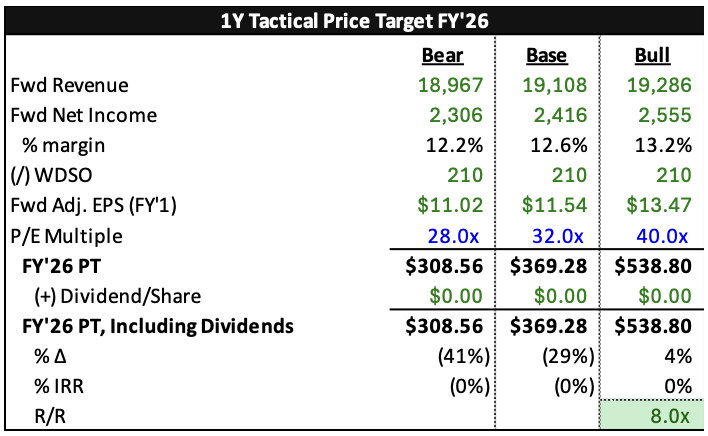
For our valuation piece, we are using DCF as a guidance rather than the outright valuation framework. We are using the P/E multiple valuation to gauge what is a fair-trading price, it’s currently trading at 34x, we think a fair multiple based is about 32x for our base case. In order capture the upside, we think for a bull case scenario a 40x multiple is fair as well.
Target price build: $369.28 = 32 (x) × FY’26 EPS of $11.54.
Risk/Reward
| BEAR - $308.56 | BASE / PRICE TARGET — $369.28 | BULL — $538.80 |
|---|---|---|
| [−41] % implied return | [-29] % implied return | 5% implied return |
Risks
1. Add-on attach comes in materially above expectations
a. Although possible, our base case assumes audiobooks, AI remixing, podcast memberships, ticketing, and higher usage tiers are more incremental than transformational. The upside risk is that the Street is right and Spotify’s highest-engagement users actually stack multiple paid features.
b. If add-on attach shows up in ARPU by FY26/FY27, the market will underwrite a higher LTV/sub and the stock likely re-rates. This would support the Street’s view that Spotify has “multiple independent vectors of pricing” rather than being dependent on headline subscription price increases.
c. Mitigant: We are watching for actual paid attach and ARPU flow-through, not engagement language. Without disclosed conversion or revenue contribution, the risk remains more narrative than numbers.
2. AI remixing becomes a real paid product with clean economics
a. The UMG deal is the biggest product risk to the short. If Spotify proves AI music can be “margin neutral or accretive,” then the bear argument around rights risk, inference cost, and label splits weakens.
b. My model assumes AI is not a major near-term P&L contributor and could create cost leakage if usage scales. The risk is that Spotify prices the feature correctly, other labels follow UMG, and AI becomes an ARPU/engagement lever instead of a COGS problem.
c. Mitigant: The burden of proof is on Spotify to show real margin drop-through after label splits, artist payouts, and compute costs. Until then, we are not giving full credit for AI revenue.
3. Ads reaccelerate faster than modeled
a. Spotify has guided to 2H26 ad growth acceleration and double-digit growth beyond. If biddable keeps mixing higher, the ad business could move from a drag to a margin-accretive growth lever.
b. My model assumes ads remain choppy and too small to drive the consolidated story. The upside risk is that active advertisers keep growing, automation improves fill/pricing, and biddable revenue carries better incremental margins than direct-sold campaigns.
c. Mitigant: Ads are still a smaller bottom-line contributor of the consolidated model, so the risk only becomes thesis-breaking if acceleration is sustained and comes with clear margin improvement.
Catalysts & Paths to Getting Paid
1) Q2/Q3 2026 Earnings Print
a. First clean read on whether the latest price hike is sticking or driving churn.
b. If Premium subs are in line but ARPU decelerates from lower-ARPU geos, the stock likely de-rates. That would confirm that subscriber growth is experiencing “empty calorie” growth and less monetizable.
c. Path to getting paid: Street estimates move lower if churn comes in above expectations, free-to-paid conversion keeps decelerating, and management must rely on international growth to offset weaker mature-market adoption. Once sell-side catches up to the print and revisions point downward, our thesis will start to realize. The tape post-investor day gives reason to believe buyside bogeys are above consensus.
Super-Premium / Pro Tier Launch Details
a. The stock has already priced in the Pro Tier narrative without proof of attach rate, pricing, or margin contribution. The next catalyst is any concrete disclosure around launch timing, price points, regional rollout, or early uptake.
b. If management gives vague engagement language instead of paid attach, ARPU lift, or revenue contribution, investors will start haircutting the Pro Tier NPV.
c. Path to getting paid: the multiple compresses if the market realizes the Pro Tier is still a long-dated story with limited near-term estimate support.
AI remix & Label-Economics Disclosure
a. UMG AI remixing is the biggest bull-case product catalyst, but the economics are still unclear. The key question is how much of the incremental revenue Spotify keeps after label splits, artist payments, and compute costs.
b. If labels claim a large share of AI revenue, or if usage carries meaningful inference cost, the Pro Tier margin thesis weakens. That directly pressures the 35-40% gross margin story.
c. Path to getting paid: gross margin assumptions get revised down if AI revenue carries normal music royalty leakage, incremental label claims, and compute costs.
Original Research Memo
Click here to view the original PDF.
Disclosures & Certification
Analyst Certification
Each author of this report certifies that (1) the views expressed herein accurately reflect his or her personal views about the subject company and its securities, and (2) no part of any author’s compensation was, is, or will be related, directly or indirectly, to the specific recommendations or views expressed in this report. SCM analysts are students and receive no compensation of any kind for research.
SCM rating system
LONG, expected to outperform the S&P 500 on a total-return basis over the stated horizon. SHORT, expected to underperform the S&P 500 over the stated horizon.
Important Disclosures
Stern Capital Management (“SCM”) is a student organization at the NYU Stern School of Business. This report was prepared by students for educational purposes only. It is not investment advice, an offer, or a solicitation to buy or sell any security, and it has not been reviewed or approved by New York University or NYU Stern. The views expressed are solely those of the student authors. Nothing herein constitutes a personal recommendation or takes into account any reader’s objectives or financial situation.
Information is drawn from public sources believed to be reliable — company filings, transcripts, press releases, and market data providers — but SCM does not guarantee its accuracy or completeness. Estimates and price targets reflect the authors’ judgment as of the report date and are subject to change without notice. Past performance is not indicative of future results.