
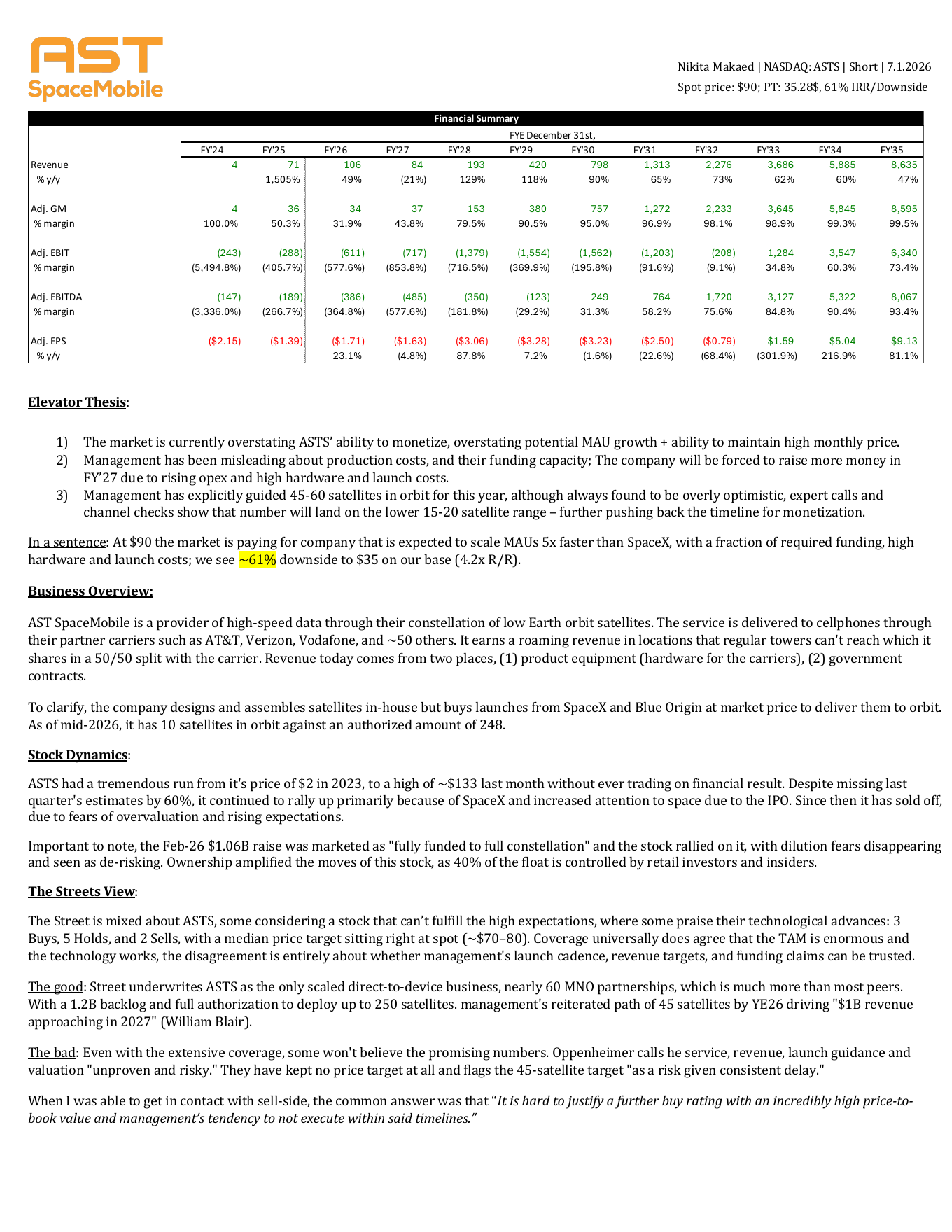
Position: At $90 the market is paying for company that is expected to scale MAUs 5x faster than SpaceX, with a fraction of required funding, high hardware and launch costs; we see ~61% downside to $35 on our base (4.2x R/R).
Elevator Thesis:
- The market is currently overstating ASTS’ ability to monetize, overstating potential MAU growth + ability to maintain high monthly price.
- Management has been misleading about production costs, and their funding capacity; The company will be forced to raise more money in FY’27 due to rising opex and high hardware and launch costs.
- Management has explicitly guided 45-60 satellites in orbit for this year, although always found to be overly optimistic, expert calls and channel checks show that number will land on the lower 15-20 satellite range – further pushing back the timeline for monetization.
Business Overview:
AST SpaceMobile is a provider of high-speed data through their constellation of low Earth orbit satellites. The service is delivered to cellphones through their partner carriers such as AT&T, Verizon, Vodafone, and ~50 others. It earns a roaming revenue in locations that regular towers can’t reach which it shares in a 50/50 split with the carrier. Revenue today comes from two places, (1) product equipment (hardware for the carriers), (2) government contracts.
To clarify, the company designs and assembles satellites in-house but buys launches from SpaceX and Blue Origin at market price to deliver them to orbit. As of mid-2026, it has 10 satellites in orbit against an authorized amount of 248.
Stock Dynamics:
ASTS had a tremendous run from it’s price of $2 in 2023, to a high of ~$133 last month without ever trading on financial result. Despite missing last quarter’s estimates by 60%, it continued to rally up primarily because of SpaceX and increased attention to space due to the IPO. Since then it has sold off, due to fears of overvaluation and rising expectations.
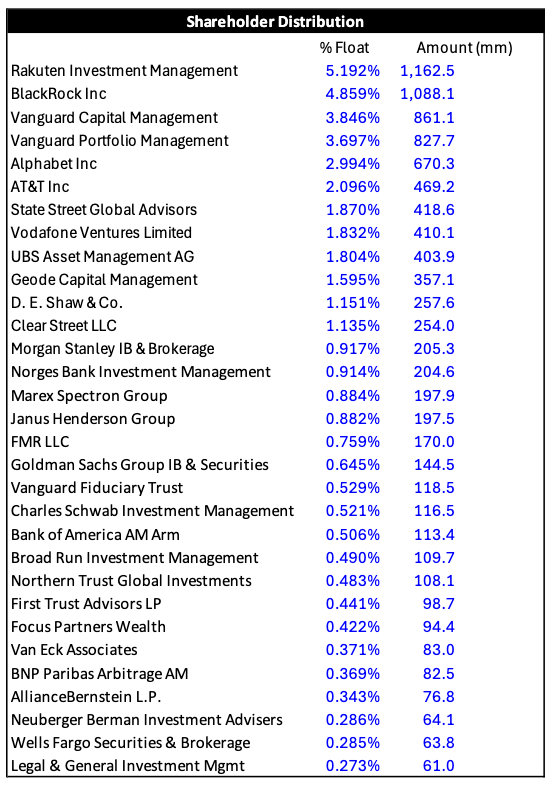
Important to note, the Feb-26 $1.06B raise was marketed as “fully funded to full constellation” and the stock rallied on it, with dilution fears disappearing and seen as de-risking. Ownership amplified the moves of this stock, as 40% of the float is controlled by retail investors and insiders.
The Streets View:
The Street is mixed about ASTS, some considering a stock that can’t fulfill the high expectations, where some praise their technological advances: 3 Buys, 5 Holds, and 2 Sells, with a median price target sitting right at spot (~$70–80). Coverage universally does agree that the TAM is enormous and the technology works, the disagreement is entirely about whether management’s launch cadence, revenue targets, and funding claims can be trusted.
The good: Street underwrites ASTS as the only scaled direct-to-device business, nearly 60 MNO partnerships, which is much more than most peers. With a 1.2B backlog and full authorization to deploy up to 250 satellites. management’s reiterated path of 45 satellites by YE26 driving “$1B revenue approaching in 2027” (William Blair).
The bad: Even with the extensive coverage, some won’t believe the promising numbers. Oppenheimer calls he service, revenue, launch guidance and valuation “unproven and risky.” They have kept no price target at all and flags the 45-satellite target “as a risk given consistent delay.”
When I was able to get in contact with sell-side, the common answer was that “It is hard to justify a further buy rating with an incredibly high price-to- book value and management’s tendency to not execute within said timelines.”
Debunking The Street:
Because there is a lot of things to talk about with ASTS, there are some things that aren’t included in my theses but worth disputing, as Street prices them as an upside source. Although less significant than my main drivers of variance, I consider them essential. So here are some of the misconceptions:
Claim #1: “Defense programs and non-communication applications, such as Golden Dome, could also be a major opportunity and upside scenario, but is difficult to measure.” Oppenheimer (May 2026); Cantor Fitzgerald frames “US Defense a Key Driver of Direct-to-Device spend” as a core pillar of its Overweight.
What’s being said here is that the upside is “difficult to measure.” However, through my research and expert calls I found that the additional upside is not real, and it’s more capped than one might think.
Government revenue is actually measurable, because the government already buys exactly this product and publishes the price it pays for it. ASTS sells connectivity, in other words data, the reason why defense contracts can’t be a significant earnings source is because it’s not weapons, sensors or missile tracking software. The market price for this data is widely available through public fillings. After some search, I’ve found that Iridium’s EMSS contract provides unlimited DoD users for a fixed ~$110M per year.
Keep in mind that’s what Pentagon pays for a mature and proven satellite franchise, the billions the bulls can point at simple aren’t there. Therefore, in my projections, government revenue ramping to ~$110M/yr by FY’32 in our Base, $160M in the Bull with SHIELD-type task orders on top, $60M in the Bear. Even doubling that amount wouldn’t move the needle, let alone 5% in valuation.
Claim #2: “AST’s contracted revenue increased to $1.2 billion” William Blair (May 2026). The Street models this backlog as near-term revenue: consensus had Q1’26 at $40–45M; the print was $14.7M, a ~65% miss, and estimates missed by a similar magnitude across the P&L.
The reason why I am short quantitively in the coming quarters is because Street is modeling the backlog wrong. Consensus treats most of the $1.2B backlog as an order book of hardware for the MNOs, however that’s wrong. By company’s own disclosure, their own hardware revenue never surpassed $100M in a single year. The other portion (~90%) of that backlog is obligations for SpaceMobile service. Revenue that cannot begin recognizing until the constellation is live and then only ratably over multi-year contracts.
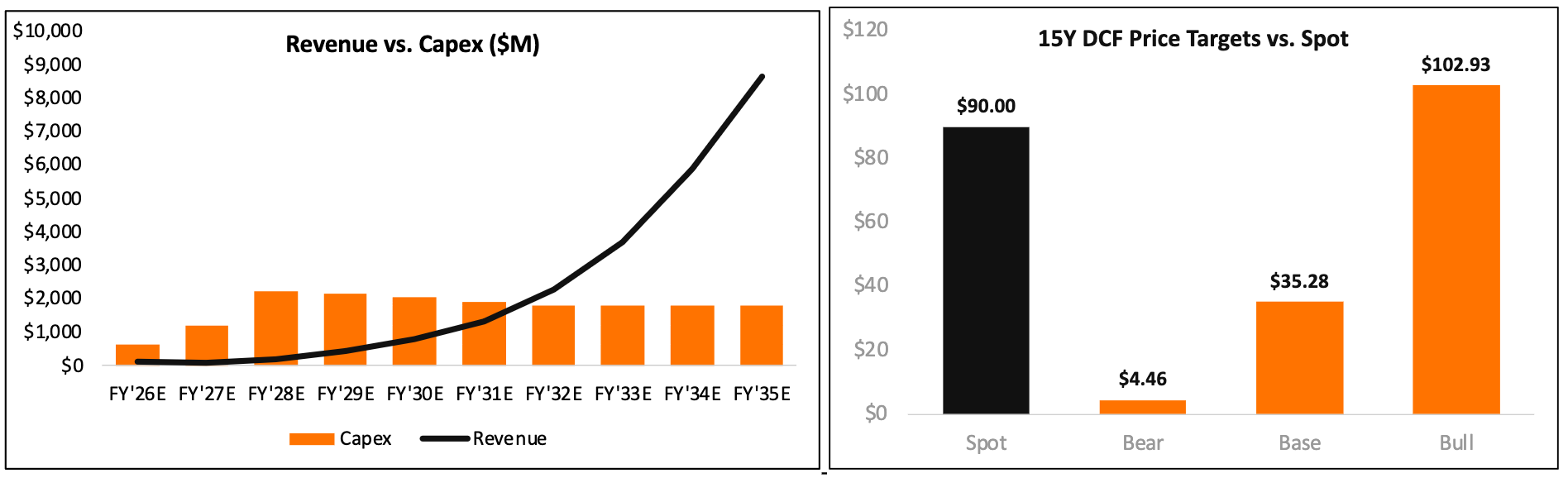
Claim #3: “ The Street models capex declining every year after deployment, where consensus has it falling from $1.5B in FY’26 to ~$840M by FY’28, completely ignoring the lifespan of the satellites and costs.
One of the biggest flaws of current consensus, is the fact that it completely fails to recognize the lifespan and coverage of these satellites. ASTS depreciates its satellites, whether the new bluebirds or the older models 2-7 years as stated in their own 10-K. Our expert calls back the lower end where the earlier Block 2s run lower duty cycles and “will need to be replaced,” these are not 15-year assets, they’re hardware in space, which will break down often. I give management the benefit of the doubt and model the high end, a full 5-year life.
The second most important part here, is that satellites launched in 2026 must be rebuilt and sent to space again in 2026. Keep in mind that to be operational in North America, they need about ~25-35. So, on top of replacing satellites they have already launched, they will need roughly 50 more to be able to deliver to most of the globe.
The fade of capex that consensus assume comes from two things, the hardware getting cheaper and launches. However, previous lead engineer says that this coming batch is going to be worth $100M a piece and the next ones won’t get dramatically cheaper. The same thing comes to launching with SpaceX or Blue Origin, Falcon 9 was “$62M ten years ago, $74M today. The costs may have come down, prices did not.
The Three Drivers of Variance:
I) Driver #1: The market is currently overstating ASTS’ ability to monetize, overstating potential MAU growth & subscription pricing.
First, it’s important to clarify again that ASTS doesn’t have subscribers. It’s a roaming deal. Per say your phone falls of the AT&T or Verizon tower grid, but you need service, it will automatically connect to one of the bluebirds (satellites) and provide you with service. At the end, AT&T pays ASTS for the usage the same way it pays a foreign carrier when you land in Mexico. The expert calls prove that “there’s a going market price for roaming for broadband data, and this will all be sold by whatever the market price for data is… it’s a roaming deal.” ASTS never touches or knows the customer and isn’t a competitor of the telecom providers, but the street tries to model it as a consumer subscription business.
Second, the price ceiling is set more than people think, funnily enough it’s actually falling. T-Mobile already includes SpaceX’s roaming data for free as a part of their premium plans and charges $10 a month on the lower tier ones. One of the expert calls help understand why that price ceiling is lowering, “AT&T and Verizon loved charging their users extra, but there’s always a third or fourth MNO in the country that gives it away, and it forces the other MNOs to do the same.” Meaning that sooner than later that service is going to be included for free to compete with each other. Since it’s a 50/50 split between telecom companies and ASTS, both hurt.
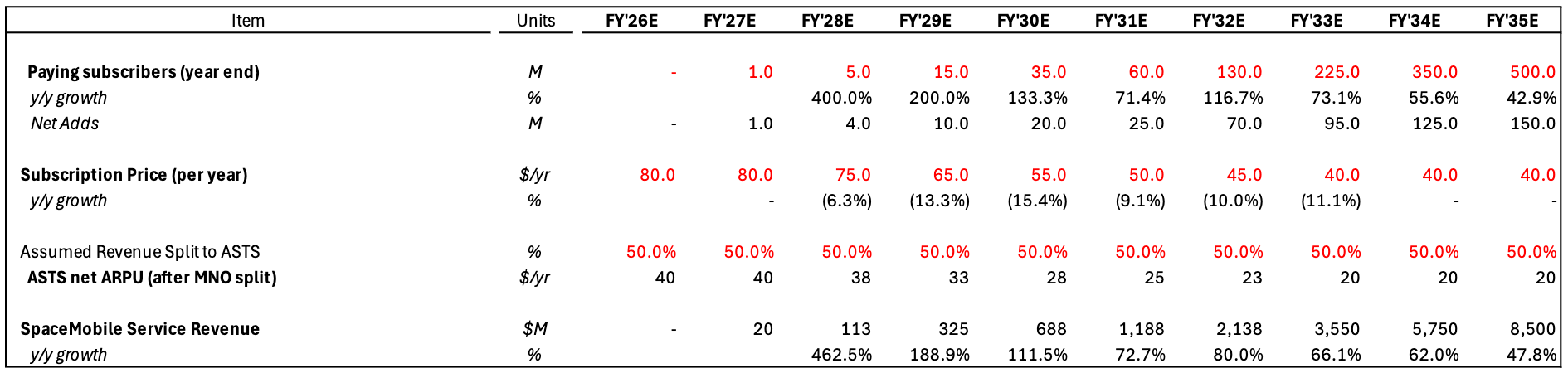
On top of that, US cannot carry ARPU on its back. Once ASTS expands globally, it will navigate markets whereas per our channel checks “the average revenue per user is maybe $2–4 a month.” Keep in mind that’s their average bill, not a satellite add-on.
Lastly, the market is assuming adoption scales faster than anything we’ve seen so far in the industry, which is a tough bet to make on a business that keeps pushing timelines back. Now Starlink took roughly 6 years to reach 12M subscribers with their own rockets and sold directly to customers and partnered with T-Mobile & Rogers. Even today SpaceX struggles to adopt their internet overseas, which means having 60 MNO agreements doesn’t mean adoption comes faster. In my base case I’m already being generous with 35M subscribers by FY’30 (roughly 4.3x times faster than SpaceX so far) with service actually starting on time and a yearly subscription cost per user of $80.
II) Driver #2: Production costs, and funding capacity of ASTS is severely overstated, and the market isn’t pricing that in.
Management has guided production of their newest Block 2 satellite to cost $21-23M all in. Due to unfortunate circumstances, their own fillings showed their lie which is why I a further sell-off wave coming.
When Bluebird 7 was lost on the New Glenn failure in April, the write-off disclosed a carrying value of $155-160M for one satellite, roughly 7x the number management vouched by. Stripping out the cost of the rocket, which runs about $70M per launch on average. We get a price of $90M per a single block of Bluebird. Now of course the bulls are going to argue that the next batch is significantly cheaper than first couple. Although that is true, an industry estimate is that doubling production decreases cost ~12% on average. Now the expert call makes it more clear, the lead engineer says that it’s going to be “more like $100M… I don’t think there’s going to be this huge drop,” “[the floor is] minimum $40, $60 million.”
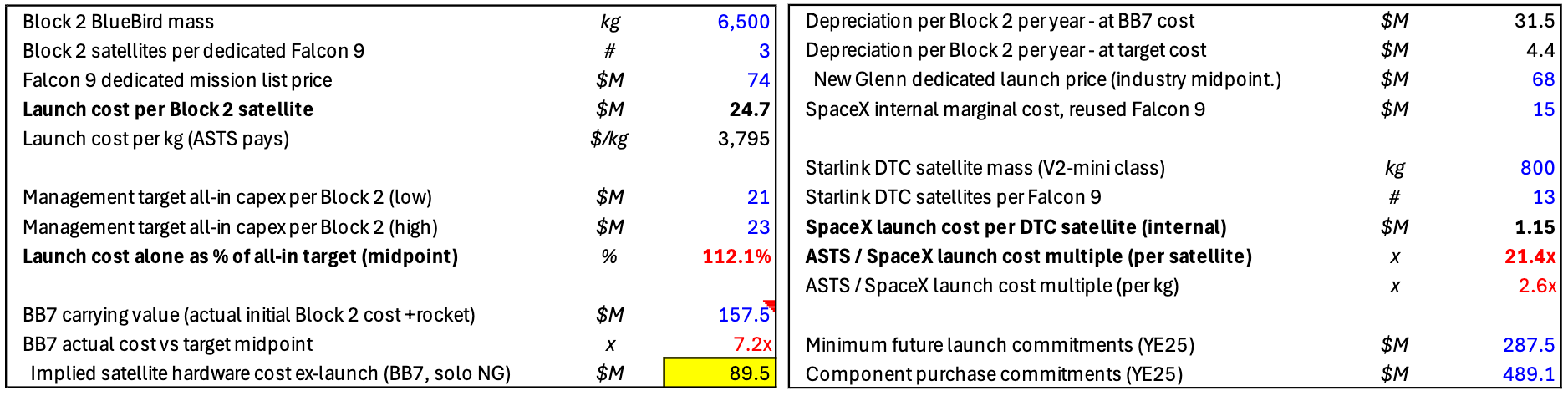
On my base case I assume a middle $50M by the end of 2031. However, that’s still 2.5x higher than what management promises. On the other note, it’s important to understand that it’s just production costs. In order to deliver it to the orbit you’re going to need another ~25M per satellite, assuming the rocket carries 3 of them. The Falcon 9 was $60M ten years ago and now charges a hefty $75M per mission. Even though this has a slim chance of working out economically, I think a bigger problem is that ASTS’ supplier is their biggest rival. I will touch on that later in the memo.
Then there is the “fully funded claim.” Management said after the Feb $1B raise that it has no plans for any additional raises. Keep in mind the program runs $1.5-2B per year. That $3.5B of cash is not going to last them. It’s funded for about ~18 months according to my calculations. A no raises this year just tells you it’s coming next year. This is also not new behavior: they have raised capital every single year of their existence, and every raise was preceded by similar funding assurances.

In my projections, getting to their constellation requires $6B of new outside capital between FY’26 and FY’31. On top of that 2B must come from equity raises, because no sane person will give all $6B of loans. First, that’s a massive amount. That dilutes the shares and causes ownership worries. That would prompt a further selloff, as of my base case I project the WDSO to reach 520m shares, 1.75x more than what they have right now.
Important to note that I assume 3-4% interest payments on their loans, however the new credit rounds for them have been rumored to pay a staggering 7% coupon. That shows that creditors see this company as more unstable than the market pretends it to be.
At the current pace, it would be a miracle for someone to fund this and let it run until it makes free cash flow in FY’2032.
III) Driver #3: Management’s guidance of 45 satellites in orbit is overstated, and market’s expectation of service launch is too.
At the current stage, ASTS has 10 satellites in orbit as of June 2026. Management guided a “minimum of 45 by year-end” on May earnings call. That means they will have to deliver 35 satellites to orbit in 6 months. That’s the same company who delivered 9 of them in the last twelve months.
Now, to be clear, that’s virtually impossible. They have currently 3 ready to launch in inventory and stated to have ~30 in production. Answers of three former insiders have ranged from 10-30 by the end of this year, reflecting high uncertainty in management’s ability. Now the major problem are not only rockets, but factories. The output is approximately 1 satellite every 1-2 months, once you include testing and integration. Now the New Glenn (Blue Origin Rocket) is grounded after the April failure for 6-12 months.
That leaves Falcon 9, which flies every 3-4 days for all missions, finally good news for the company. However, 80% of those launches are Starlink missions. It gets worse, almost all the missions are pre-planned with contracts signed 6 months in advance before launch (that’s the lower end of 6-12 months). On top of that, SpaceX is a direct competitor whose interest is to not let a competitor into their market. That means they have full leverage of their next 1–2-year launch schedules, if they decide not to let them onto the market for another 2 years, ASTS can’t do anything about it, which is a huge red flag on itself. Relying on a competitor to deliver your satellites to orbit.
No matter how hard they try, North America coverage is a 2028-2029 event. With company’s own math, though overly optimistic, ~25 satellites get you limited, noncontinuous service (phone works sometimes, in some places), and you need 45+ for continuous coverage in the key markets. By 2031-2032 ASTS should have capacity to cover most of the globe’s hot spots.
Important to know that ASTS stated that they need 90 satellites to go global, but the big antenna buys bandwidth, not necessarily coverage, their own FCC filing (248 satellites) tells you what ‘full constellation’ they actually need. Nobody files for 248 if 90 finishes the job, my guess is that they are going to need at least 150-200 of them to cover their most profitable markets. However, to give them the benefit of the doubt and a large cushion on my short, I am going to assume management’s targets.
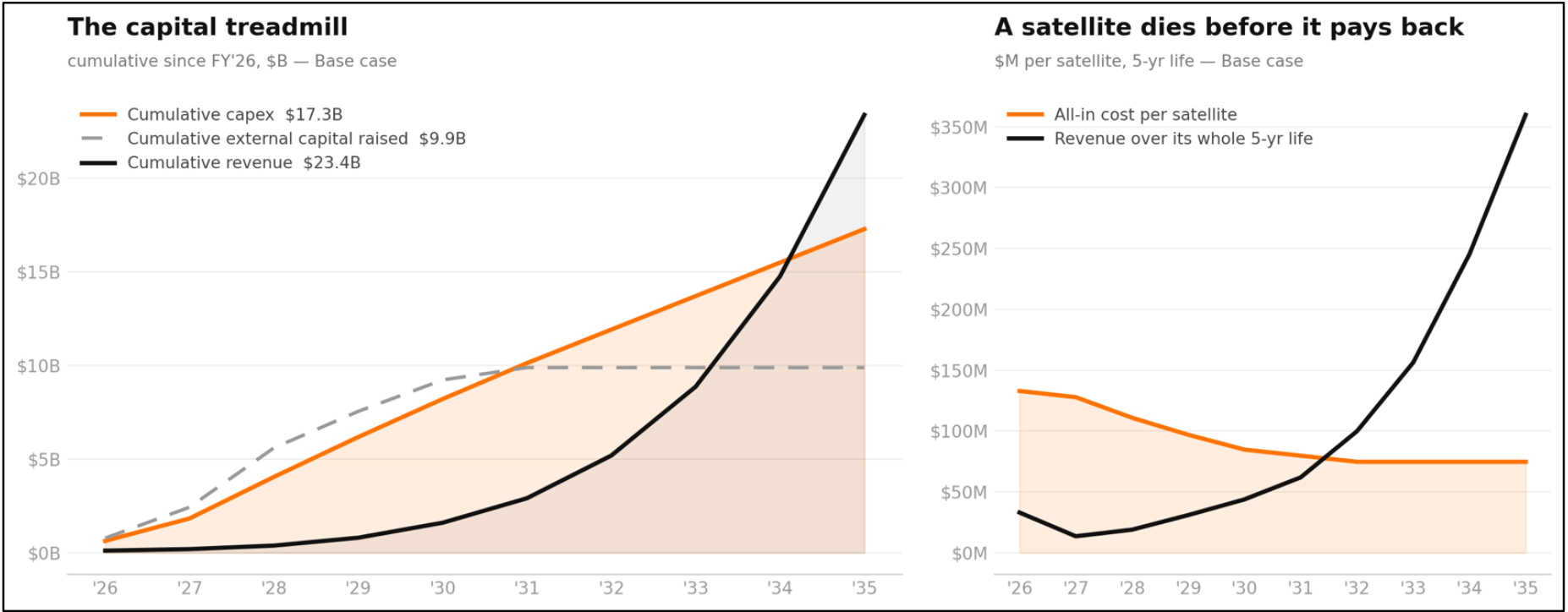
Now the reason why their launch schedule is important is because the longer they take the more the previous satellites depreciate, meaning that billion-dollar capex goes to nothing. In their case, failing to launch their SpaceMobile roaming system by FY’28-FY’30 will almost guarantee their bankruptcy, in which case you make a 100% on this short, which is a real scenario in this industry.
Current Competition Story:
ASTS operates in maybe the only industry where your direct competitor can control your production schedule. I consider this one of biggest reasons why I am short the stock. SpaceX runs T-Satellite with T-Mobile today at $10/month, with most of their target amount up in the atmosphere. At the same time ASTS pays a hefty $75M per launch to SpaceX, to get their satellites in the air. Blue Origin was the alternative, and it’s grounded after the April failure that destroyed BB7. The entire deployment schedule is reliant on their competitor. IF SpaceX ever decides that ASTS is a real threat to their business, they won’t need to outcompete them, just delay their launches.
The fact that SpaceX keeps flying them tells you everything you need to know. Right now, every ASTS launch is a trade that SpaceX wins, it collects the rocket costs. Not to mention that SpaceX will be the top choice for the roaming data for the next couple years, as their coverage is going to be much more quality due to the amount they already launched. Now, obviously satellites ASTS provides are bigger and have more coverage so, adjusting to the number of coverages per satellites, it still gets SpaceX ahead on coverage for a couple of years.
Now there is an argument to be made that when Blue Origin comes back up it can use their rockets, however now with less confidence that it will reach the orbit. In one of my calls, I found out that they see a max of 3-6 satellites per New Glenn and that may be optimistic.
Valuation & Risk/Reward
For our valuation, we are using a 15-year DCF. A DCF is the only honest tool here that values the company fairly. Firstly, because their launches and satellite production and all costly expenditures aren’t recorded on the income statement. Which makes their gross margin and EBIT margin look as great as a software company’s. When you actually take into consideration that they will have to keep replacing satellites and producing them, that changes the picture.
Second, the company has no earnings, no EBITDA, and won’t for years, so any multiple-based target is just a story with a number attached. Fifteen years because that’s what it actually takes: service starts ~2027–28, scale arrives in the 2030s, and anything shorter would be valuing a valuating a construction site of a condo that has nothing there.
Now before we get into my cases, I think it’s important to note that I tended to be very generous across MAU adoption, hardware costs and satellite coverage required to start service, basically took a lot of management’s projections as they said to give this short a big cushion, that even if they miraculously execute on some of their targets, I can get a more than fair valuation.
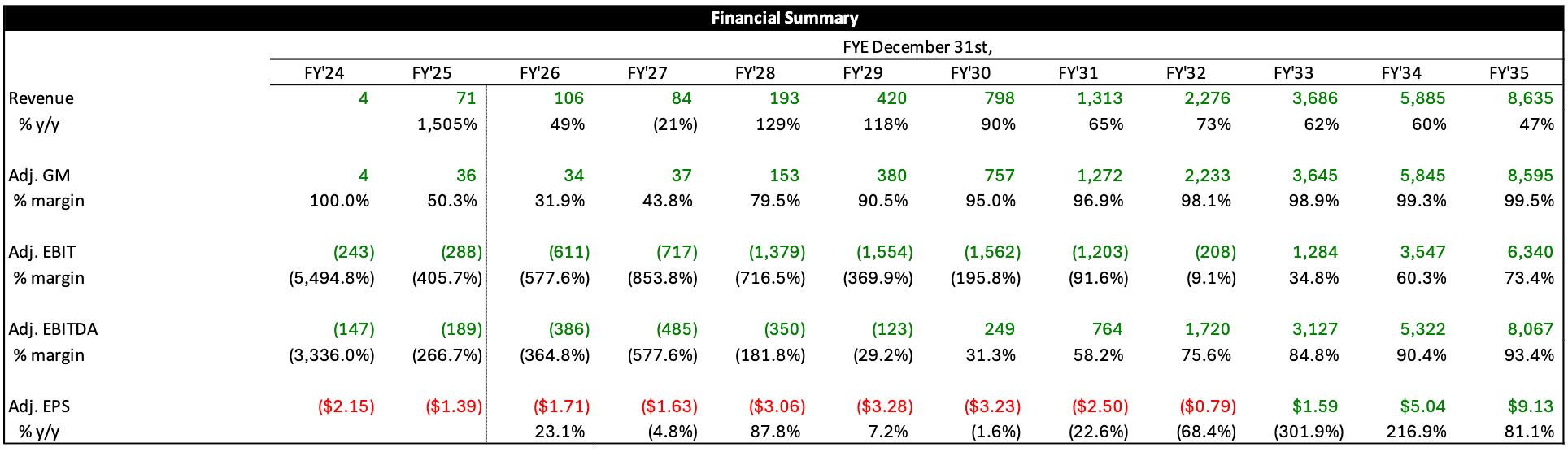
Base case: $21 (−76%). This is the case where I’m generous and the stock still loses three quarters of its value. I give them 16 satellites by YE26 (middle of the insider range), service scaling to ~500M subscribers by FY’35, hardware costs falling ~40% to a $60M floor. Then continues to decel slowly further into 2040.
Bull case: $131 (+46%). To get here I need ~750M subscribers by FY’35 with much higher price retention, hardware on the lowest end of the expert calls by early 2030s and launches that don’t get delayed which ramp to just under 30/year by 2029. By FY’30 I have them reaching 52.5M subscribers which is 6.5x times faster than Starlink scaling in the past. In this scenario they start producing positive FCF in 2031, growing revenue to ~16B in 2035.
Bear case: $4.46 (-95%). This is arguable one of the most important paragraphs in the memo as it explains why the risk reward is much more skewed when looking at the bear case. Although my PT for my bear case is in the single digits, the real PT is $0. Very bold to say, I’ll explain why. The key reason why this company will go bankrupt is because of its long runway before any monetization, meanwhile capex is outrageously large. In my bear case they are going to have
to take an outrageous 10B worth of debt that is mixed between equity and loans. To put it simply, no creditor will give them 7B worth of loans, today their coupons are already bouncing around the 5-7% mark, which means even if they do receive it – it’s going to destroy their long-term value due to outrageously big interest payments. That’s the bear case, the company will need so much debt and issuances to keep operating, that it will either cease to exist or pay ~300M worth of interest every year assuming 4% coupons, that number jumps to $500M at their current borrowing rates.
Risks:
- The stock trades on announcements. Heavy retail concentration (the “SpaceMob”). Launches, MNO deals, and spectrum headlines move the stock ±10% regardless of financials. A successful June launch or Telus-style partnership can rip the short.
a) Mitigant: Most catalyst are checkable and are public information, so tracking authorizations for flights through public sources can give early tells and protect some of the position if market might rally on it. Though there are much more negative catalysts coming rather than positive at least for the next 6 months.
- Blue Origin comes back faster than expected and they are able to launch 6-7 satellites per rocket, scaling to 20+ in orbit per year by FY’27.
a) Mitigant: Now this is a genuine risk to the short as that would at least put them on a faster track to launching their service and having a headstart on user growth. However, with the recent failure I doubt that they consider Blue Origin a reputable source to deliver their satellites in the near future. Let alone give them 6 satellites per launch with high failure rate.
- A Golden Dome task order, an SDA award, or any “DoD selects AST.
a) Mitigant: Yes, if they headline a government contract, the initial reaction would be sending the stock ~5-10% upwards. However, from the previous research we know that ASTS can’t bring a any valuable data for more than $150M per year, that means that if award is not disclosed entirely, the next earnings disappointment on contract revenue will send the stock down even more, which gives another time play opportunity.
- ARPU comes in higher than expected.
a) Mitigant: Although highly unlikely due to competitiveness of US telecom providers, there is a chance that ASTS will be able to retain pricing power at first, which will pop the stock up if SpaceMobile service starts on time.
Catalysts and Path to Getting Paid:
- The YE26 satellite count + launch announcements (the biggest near term).
One of the highest values of holding this short is having no news. Because the street will keep repricing ASTS by day the longer they take to announce the next launch. Now the other is how many satellites they are going to have by the end of the year. With no coming announcements I can confidently see the stock derate ~5% in this coming month.
- The next raise, late ’26 / 1H’27.
No plans for additional raises this year“ expires December 31. Their yearly cash burn is $1.5-2B regardless of my case selection, which means against their 3.6B cash, they have about 18 months’ worth of service. I expect them to raise once cash falls below ~$750M (very possible earlier but that’s the threshold they don’t want to cross.
- Quarterly prints, Aug ’26, Nov ’26.
Now the coming quarters aren’t as important as the earnings call within them. Historically ASTS missed pretty much every single quarter, and they won’t be hitting them any time soon. Sell-side specifically is severely overstating their numbers, which should now clearly be seen. The deal breaker is going to be what management says and their tone, everyone will expect less & less of managements guidance, but certainly anything on the worse end of not to street’s expectations will de-rate it the most
- Service reality
The reality is that 25 satellites are likely not to cover US or Canada. Though yes, their satellites are bigger than SpaceX’s per say, they buy use bandwidth (connectivity quality), not necessarily hugely larger coverage area. In the near future I expect them to release the “beta” SpaceMobile roaming, as once they reach 25 satellites, they won’t be sufficient enough to operate anywhere close being a full-time provider. That will push the timelines for monetization even further and de-rate the stock.
Appendix:
Figure #1: General Information
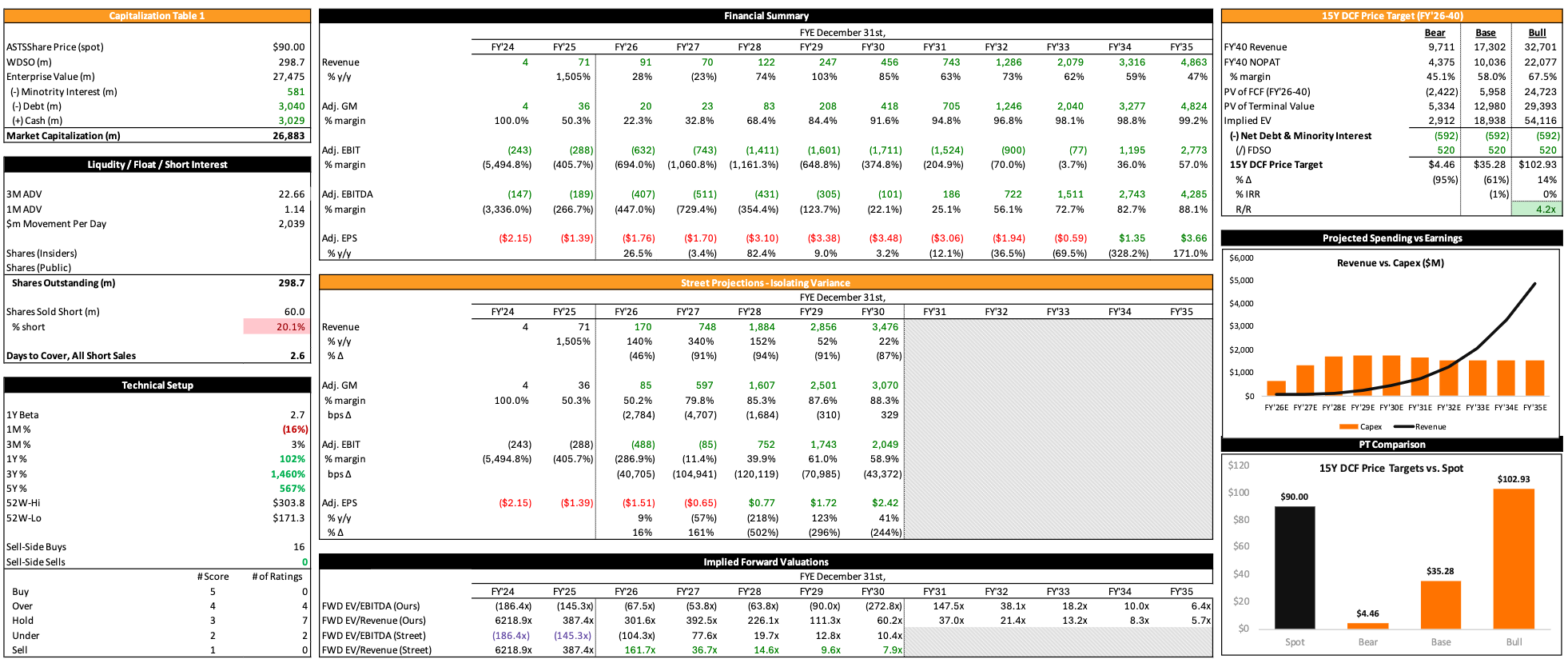
Figure #2: Sizing & Risk-Reward
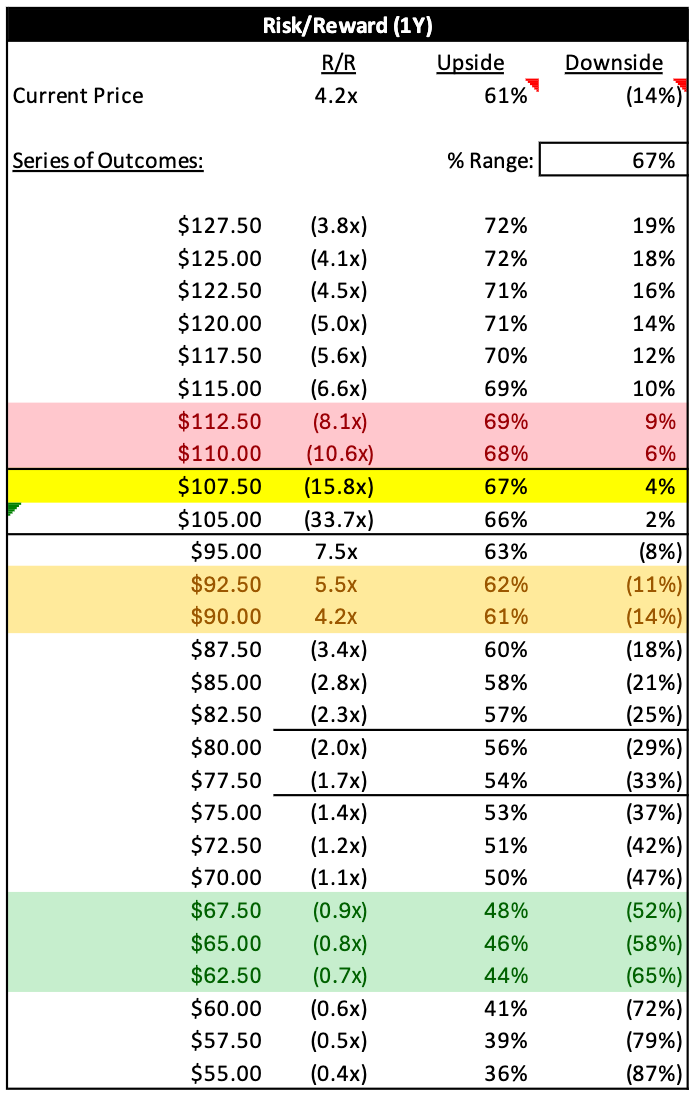
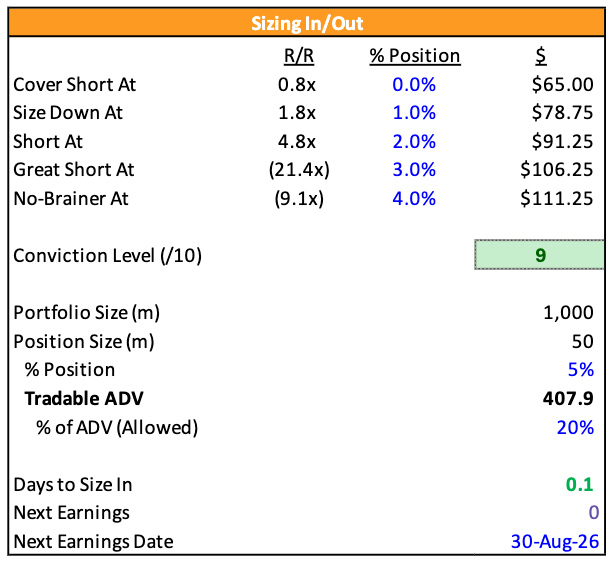
Figure #3: Valuation
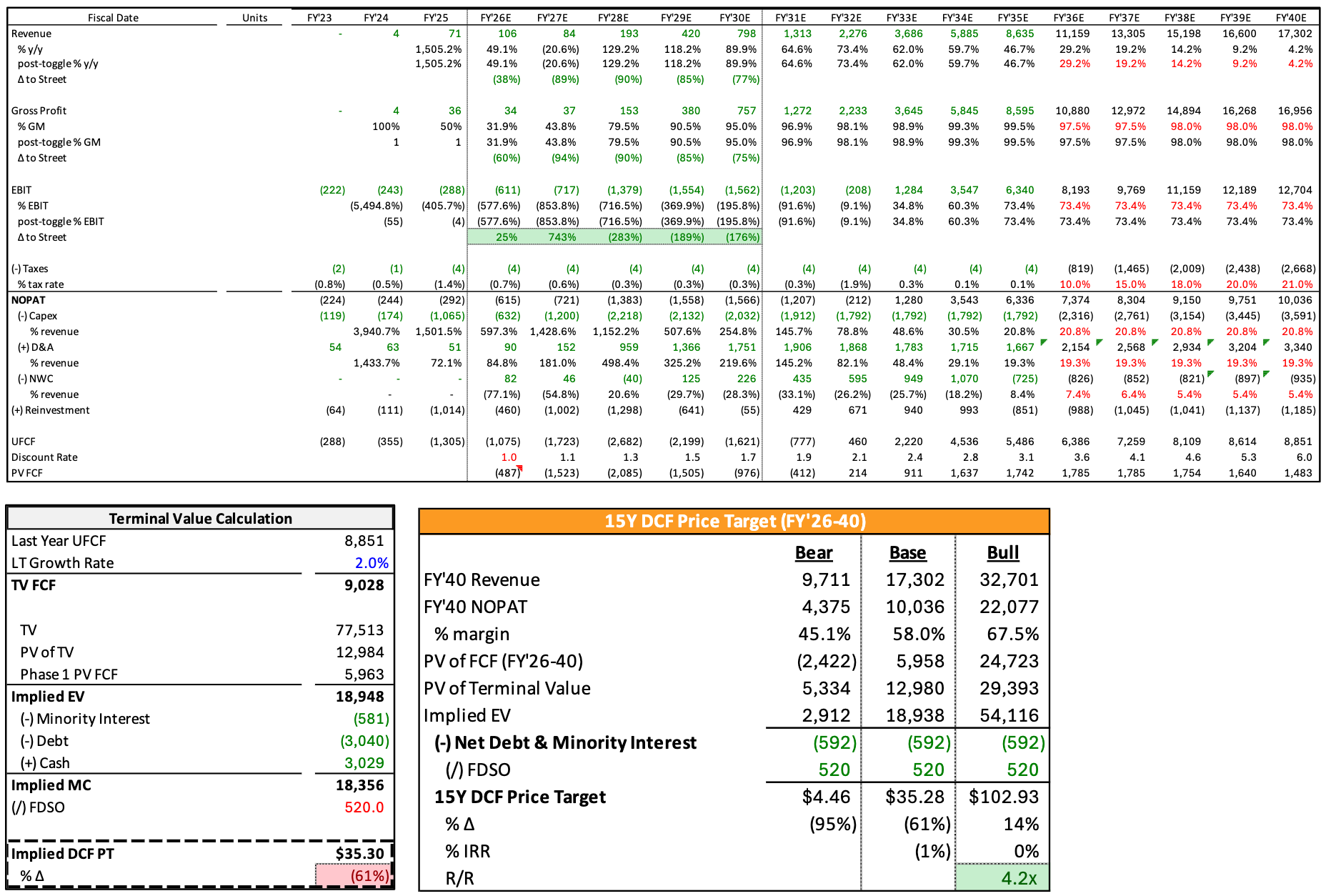
Figure #4: Variance to Street
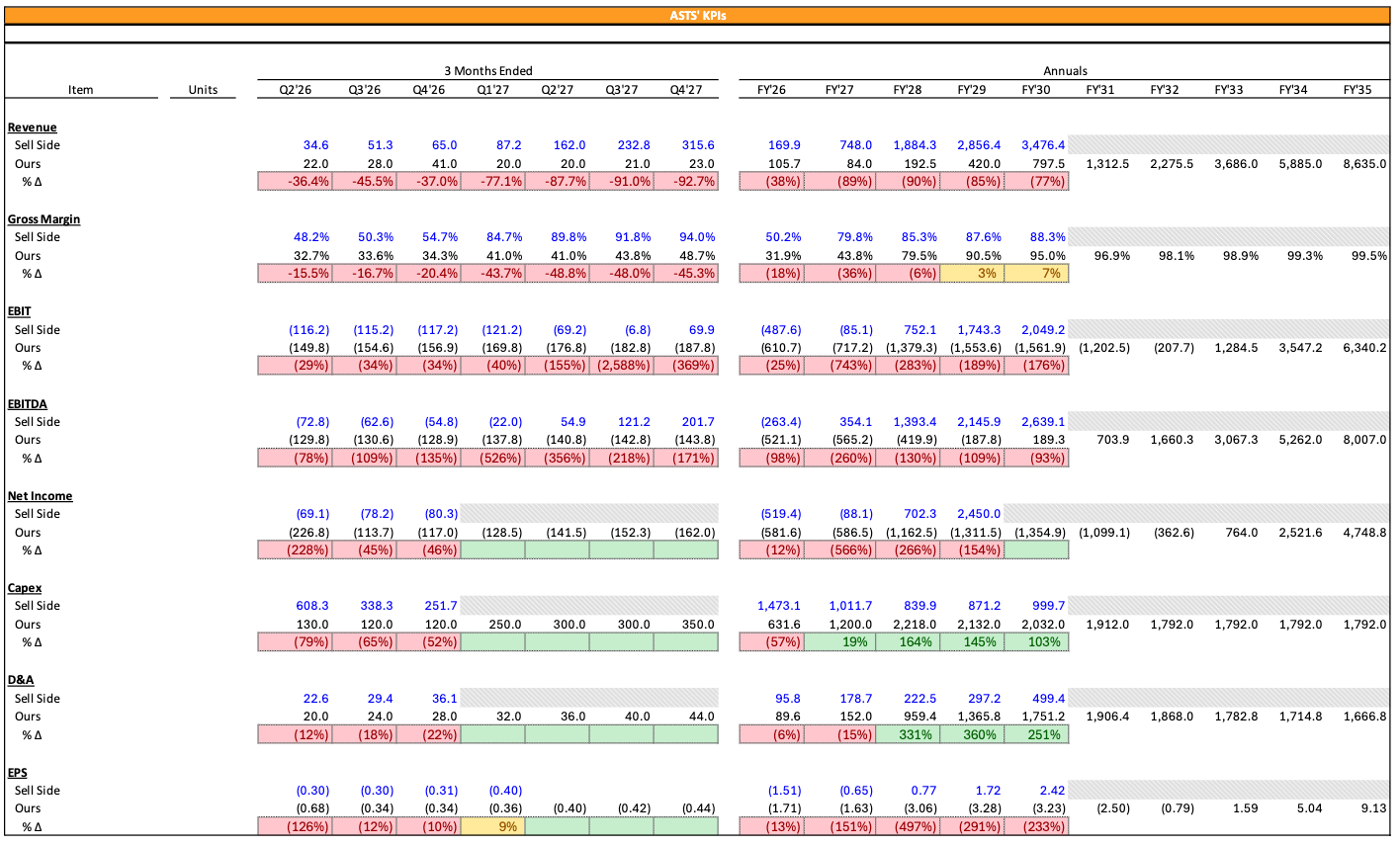
Figure #5: Launch Schedule & Constellation
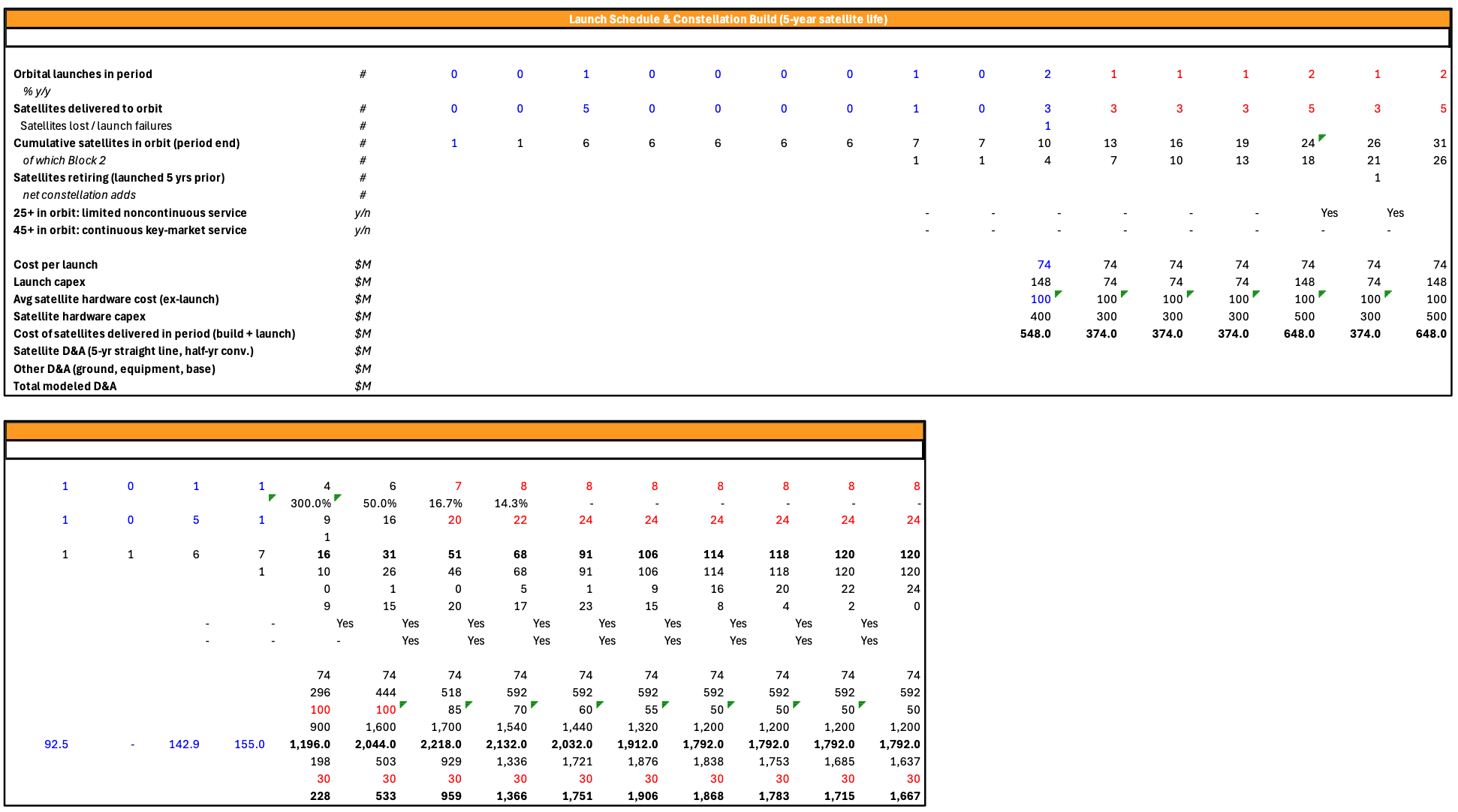
Figure #6: Shareholder Distribution
Original Research Memo
Click here to view the original PDF.
Disclosures & Certification
Analyst Certification
Each author of this report certifies that (1) the views expressed herein accurately reflect his or her personal views about the subject company and its securities, and (2) no part of any author’s compensation was, is, or will be related, directly or indirectly, to the specific recommendations or views expressed in this report. SCM analysts are students and receive no compensation of any kind for research.
SCM rating system
LONG, expected to outperform the S&P 500 on a total-return basis over the stated horizon. SHORT, expected to underperform the S&P 500 over the stated horizon.
Important Disclosures
Stern Capital Management (“SCM”) is a student organization at the NYU Stern School of Business. This report was prepared by students for educational purposes only. It is not investment advice, an offer, or a solicitation to buy or sell any security, and it has not been reviewed or approved by New York University or NYU Stern. The views expressed are solely those of the student authors. Nothing herein constitutes a personal recommendation or takes into account any reader’s objectives or financial situation.
Information is drawn from public sources believed to be reliable — company filings, transcripts, press releases, and market data providers — but SCM does not guarantee its accuracy or completeness. Estimates and price targets reflect the authors’ judgment as of the report date and are subject to change without notice. Past performance is not indicative of future results.